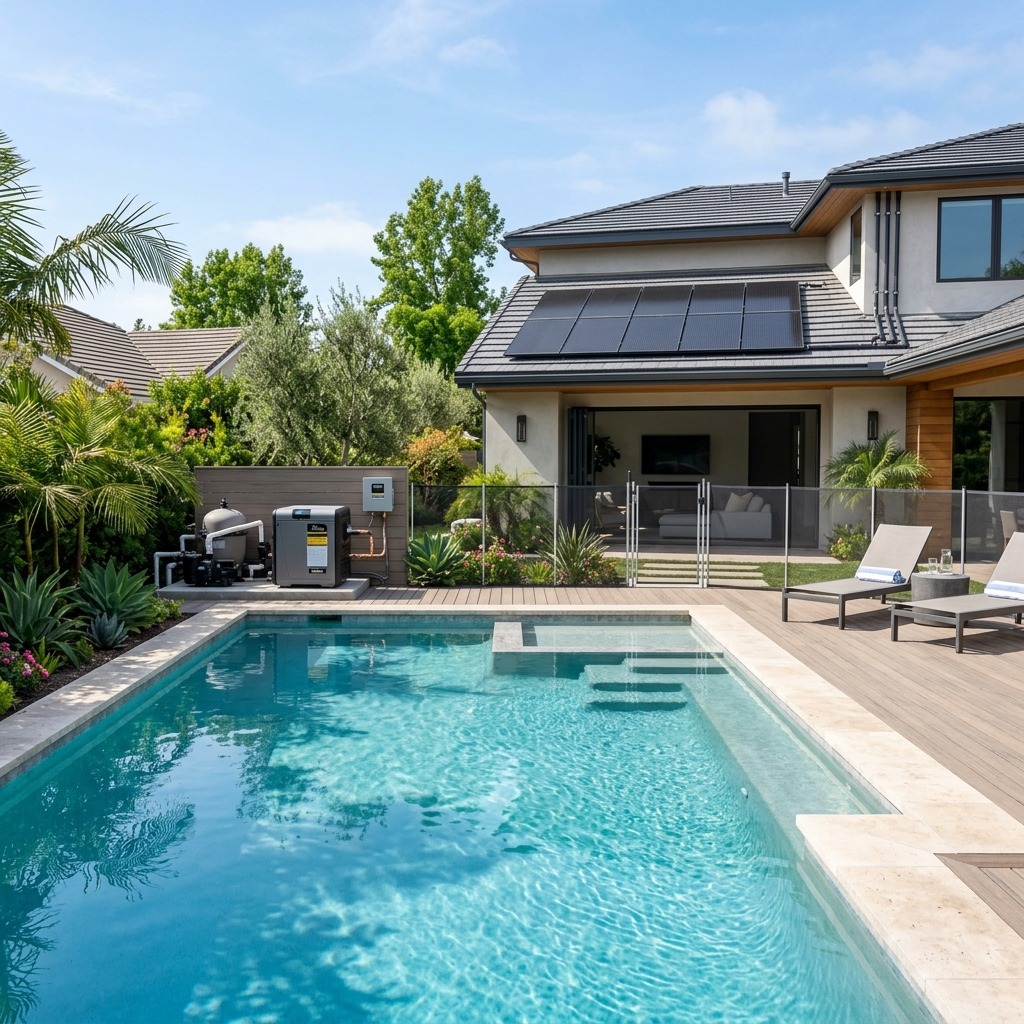
Extending your swimming season into early spring and late autumn requires a reliable pool heating system. However, upfront equipment purchase prices, installation requirements, and monthly utility bills vary dramatically depending on whether you choose a natural gas heater, liquid propane unit, electric heat pump, or solar thermal collector panel array.
In 2026, total pool heater installation costs range from $2,400 to $7,800, with monthly operating expenses ranging from $25 to over $480 depending on fuel choice, geographic climate zone, and target water temperature.
1. Comprehensive Pool Heater Technology Comparison
| Heater Technology | Installed Purchase Price | Monthly Running Cost | Heating Speed & Performance |
|---|---|---|---|
| Natural Gas / Propane | $2,200 – $4,800 | $200 – $480+ | Fastest heating (1–2°F/hr). Operates in any air temperature. |
| Electric Heat Pump | $3,500 – $6,800 | $50 – $160 | High efficiency above 50°F air. Slower, steady heating. |
| Solar Thermal Collector Array | $3,200 – $7,500 | $0 – $25 (Pump power) | 100% free solar heating. Dependent on sunlight & roof area. |
| Hybrid Gas + Solar System | $5,500 – $11,000 | $40 – $120 | Instant heat on demand with low baseline operating cost. |
2. Natural Gas & Propane Heaters: Rapid Heat on Demand
Gas pool heaters burn natural gas or liquid propane inside a combustion chamber, transferring thermal energy through a cupro-nickel heat exchanger. Gas units remain the top choice for attached spa combinations because they heat water rapidly regardless of outdoor air temperature.
- Sizing Specifications (200k to 400k BTU): Sized based on pool surface area and temperature rise requirements.
- Installation Code Compliance: Requires a dedicated gas line run and ventilation installed per National Fuel Gas Code (NFPA 54) specifications.
- Utility Bill Impact: Running a 400,000 BTU gas heater continuously can add $300 to $500 to monthly utility bills during cold months. Calculate operating costs with our Gas Pool Heater Cost Calculator.
3. Electric Heat Pumps: High-Efficiency Low Monthly Bills
Heat pumps consume electricity to run a compressor and fan, extracting ambient heat from surrounding air and transferring it to pool water via a titanium heat exchanger. Because they move existing heat rather than burn fuel, they operate at up to 500% Coefficient of Performance (COP).
- Optimal Climate Zone: Most effective in southern and mid-Atlantic states where ambient air remains above 50°F (10°C).
- Monthly Running Costs: Consumes $50 to $160 per month, saving up to 70% in energy costs compared to gas units.
4. Solar Pool Heating: Zero Monthly Fuel Bills
Solar pool heating systems utilize solar collector panels mounted on your roof. Your existing pool pump circulates water through solar tubes where solar radiation warms the water before returning it to the pool.
- Roof Area Requirement: Requires unshaded roof space equal to 50% to 100% of pool surface area.
- Payback Period: Higher upfront installation costs ($3,500–$7,000) are offset by zero fuel bills, yielding full financial payback within 3 to 5 years. Calculate solar panel requirements using our Solar Pool Heater Cost Calculator.
5. How Pool Covers Cut Heating Bills in Half
Evaporation accounts for approximately 70% of total pool heat loss. Using a solar pool cover or liquid solar blanket retains heat and dramatically lowers utility bills:
- Solar Bubble Covers ($120 – $300): Traps heat overnight and increases water temperature by 8°F to 15°F.
- Automatic Safety Covers ($5,000 – $12,000): Certified to ASTM F1346-91 safety standards, providing automated pool cover protection and thermal insulation.
Integrate heating bills into your Monthly Pool Maintenance Budget Guide.
Frequently Asked Questions (FAQ)
Which pool heater is cheapest to run?
Solar pool heaters are the cheapest to run ($0 per month in fuel). Electric heat pumps are the second most economical ($50 to $160 per month), while natural gas and propane heaters are the most expensive ($200 to $480+ per month).
How long does it take a gas heater to heat a pool?
A 400,000 BTU gas heater raises pool water temperature by 1°F to 2°F per hour for a standard 20,000-gallon pool.
Calculate Your Complete Heating & Building Budget
Planning heater installation or calculating pool construction costs? Try our free Gas Pool Heater Cost Calculator, Solar Pool Heater Cost Calculator, and Inground Pool Cost Calculator. Review our Cost Estimation Disclaimer and Contact Support Desk for help.
6. Detailed Step-by-Step Pool Heater Sizing Formula
Calculating the exact BTU rating or heating capacity required for your swimming pool prevents under-sizing (which leads to continuous running) or over-sizing (which causes short-cycling):
Step 1: Calculate Pool Surface Area
Determine surface area in square feet: Area = Length x Width for rectangular pools. For round pools: Area = 3.14159 x Radius squared.
Step 2: Determine Required Temperature Rise
Subtract average ambient air temperature during coldest swimming month from target water temperature (e.g., 80 degrees target minus 60 degrees air equals 20 degrees rise).
Step 3: Apply the BTU Formula
Use the standard pool heating formula: Required BTU per hour equals Pool Surface Area in square feet multiplied by 12 multiplied by Temperature Rise in degrees Fahrenheit. For example, a 16×32 pool (512 sq ft) requiring a 20 degree rise needs: 512 x 12 x 20 = 122,880 BTU per hour. Contractors recommend selecting a 250,000 or 400,000 BTU gas heater for rapid thermal recovery.
7. Heater Maintenance & Heat Exchanger Preservation
Protecting internal heat exchangers against premature chemical erosion extends heater lifespan significantly:
- Preventing Acid Corrosion: Low pH water (below 7.2) rapidly corrodes copper and cupro-nickel heat exchanger tubes. Maintain pH between 7.4 and 7.6.
- Preventing Scale Accumulation: High calcium hardness (above 400 ppm) combined with high water temperatures causes calcium scale to coat heat exchanger tubes, restricting flow and triggering high-limit thermal safety cutoffs.
- Installing Chemical Check Valves: Always install a positive-seal corrosion-resistant check valve between chlorination equipment and heater outlet to prevent back-siphoning of concentrated chlorine gas when pump turns off.
8. Comparing Installation Code Standards
All pool heater installations must comply with stringent national safety and municipal building codes:
- Gas Heater Code (NFPA 54 / ANSI Z223.1): Mandates minimum clearances from combustible walls, proper gas pipe sizing, sediment traps, and vertical chimney vent termination.
- Electric Heat Pump Code (NEC Article 680): Requires dedicated 50 to 60-amp 240V double-pole circuit breakers, heavy-gauge copper bonding wire connected to pool bonding grid, and local disconnect switches within sight.
- Solar Thermal Code (Uniform Solar Energy Code): Governs roof attachment flashing, wind uplift resistance, and vacuum relief valve air purging.
9. Seasonal Heating Strategies & Smart Thermostat Automation
Maximizing pool heating efficiency requires implementing smart thermostat controls and automated scheduling. Running pool heaters continuously at 85 degrees Fahrenheit increases monthly fuel bills significantly. Implementing smart controls cuts energy consumption by 30% to 50%:
- Automated Temperature Setbacks: Program digital pool automation systems (such as Pentair IntelliCenter or Hayward OmniLogic) to lower pool water temperature to 75 degrees during weekdays and ramp up to 82 degrees only on weekends when swimming occurs.
- Integrating Solar Pre-Heating: In hybrid gas-solar systems, configure automation software to prioritize zero-cost solar thermal heating as the primary heat source. The gas heater fires automatically only if solar radiation fails to maintain target temperatures.
- Optimizing Circulation Flow Rates: Variable-speed pumps operating at lower RPMs increase thermal contact time inside heat exchangers, improving thermal transfer efficiency while reducing electrical pump consumption.
10. Environmental Impact & Carbon Footprint Comparison
Evaluating the environmental impact of your pool heating choice helps reduce household carbon emissions:
- Natural Gas Carbon Footprint: Burning natural gas releases approximately 11.7 lbs of CO2 per therm of gas consumed. A 400,000 BTU heater operating 20 hours monthly generates over 900 lbs of carbon emissions.
- Electric Heat Pump Emissions: Heat pumps produce zero direct site emissions. When powered by solar photovoltaic panels or green grid power, heat pumps deliver near-zero carbon pool heating.
- Solar Thermal Environmental Benefits: Solar thermal collectors produce 100% clean renewable heat without burning fossil fuels or consuming utility grid power.