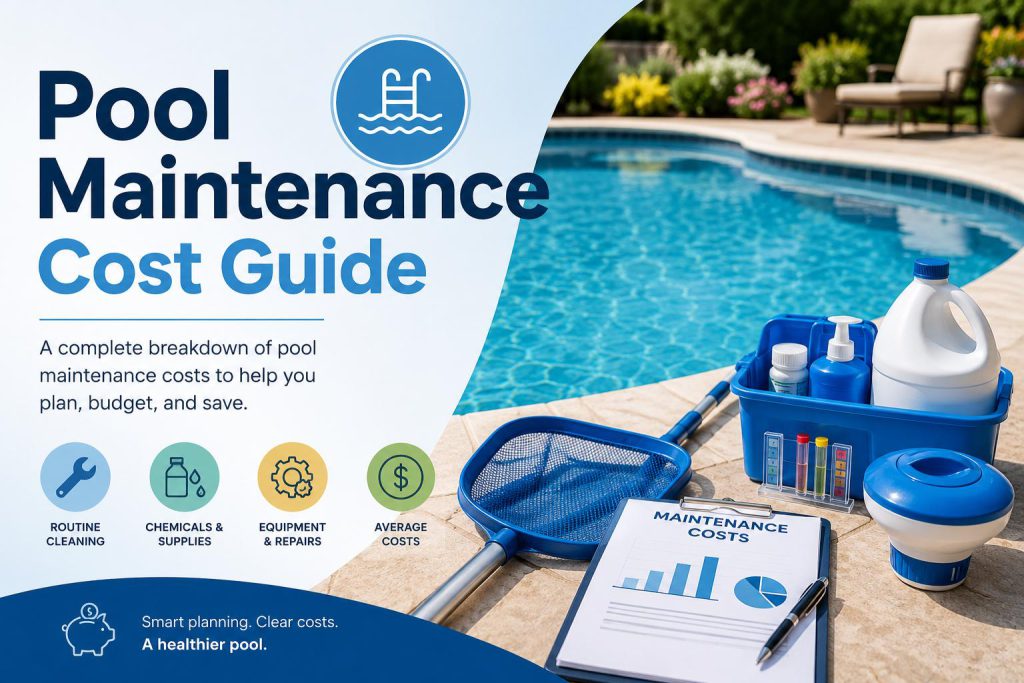
Most homeowners research pool construction costs thoroughly. They compare pool types, get multiple contractor quotes, and budget carefully for excavation and decking. Then they build the pool, fill it up, and encounter the part they never priced out: what it actually costs to own and operate a pool, every single month, for the next 20 years.
The gap between build cost and ownership cost is where pool budgets consistently fail. A pool that fits comfortably in your construction budget can strain your monthly finances if you didn’t account for chemicals, utility bills, equipment maintenance, and periodic structural renewal. This guide gives you the complete picture — every recurring cost, every replacement schedule, every seasonal expense — so you can build a realistic annual pool ownership budget before the water goes in.
For context on how maintenance costs fit into the full pool budget picture, see our pool cost calculator vs estimator complete guide.
Key Takeaways
– DIY pool owners pay $100–$200/month in chemicals, utilities, and supplies. Professional service adds $80–$200/month in labor.
– Pool type significantly affects maintenance cost: fiberglass pools have the lowest ongoing chemical costs; concrete pools have the highest.
– Vinyl liner pools require a $3,500–$7,000 liner replacement every 7–10 years — a major planned expense.
– Concrete pools need replastering every 10–15 years at $5,000–$15,000 — the largest maintenance expense in any pool type.
– Seasonal opening and closing costs run $250–$900/year depending on climate and whether you hire professionals.
– Proactive maintenance is dramatically cheaper than reactive repairs — skipping regular care accelerates equipment failure and structural deterioration.
1. The True Monthly Cost of Pool Ownership
Before itemizing specific costs, here’s the overview: what pool ownership actually costs per month in 2026, across the spectrum of pool types and management approaches.
| Cost Category | DIY Monthly | Pro Service Monthly | Notes |
| Chemicals (chlorine, pH, algaecide, stabilizer) | $50–$120 | Included in service | Fiberglass ~30% lower |
| Professional pool service | — | $80–$200 | Weekly visits |
| Electricity (pump & filter) | $30–$80 | Same | Variable-speed pump saves 50-80% |
| Heating (gas or heat pump, seasonal) | $100–$400 | Same | Not year-round in most climates |
| Equipment maintenance fund | $20–$50 | Same | Prorated for expected replacements |
| Total DIY | $200–$650 | — | Seasonal average |
| Total with Pro Service | — | $280–$850 | Seasonal average |
Chemical Costs ($50–$150/month)
Chemical management is the most consistent ongoing pool expense. The standard maintenance regimen includes: chlorine tablets or liquid (the primary sanitizer, $15–$40/month), shock treatment (weekly or biweekly chlorine boost, $8–$18/month), pH adjustment chemicals (pH up/soda ash + pH down/muriatic acid, $8–$20/month), algaecide (preventive monthly treatment, $5–$10/month), cyanuric acid/stabilizer (once or twice per season, $10–$30 per application), and water testing kits or professional water analysis ($10–$25/month).
Total chemical spend for DIY management: $50–$120/month during the swimming season. In warmer climates where pools run 10–12 months per year, annual chemical costs are $600–$1,440. In colder climates with 5–6 month seasons, $300–$720/year.
Professional Pool Service ($80–$200/month)
A weekly pool service visit typically includes: water chemistry testing and chemical adjustment, skimmer basket cleaning, brush-down of pool walls and steps, vacuum (or robotic cleaner oversight), and equipment visual check. Service packages vary: basic chemical-only visits run $80–$130/month; full service including vacuuming and equipment inspection runs $150–$200/month. Service companies typically charge 10–15% more in summer months due to higher chemical demand and greater visit complexity.
Electricity for Pump & Filter ($30–$80/month)
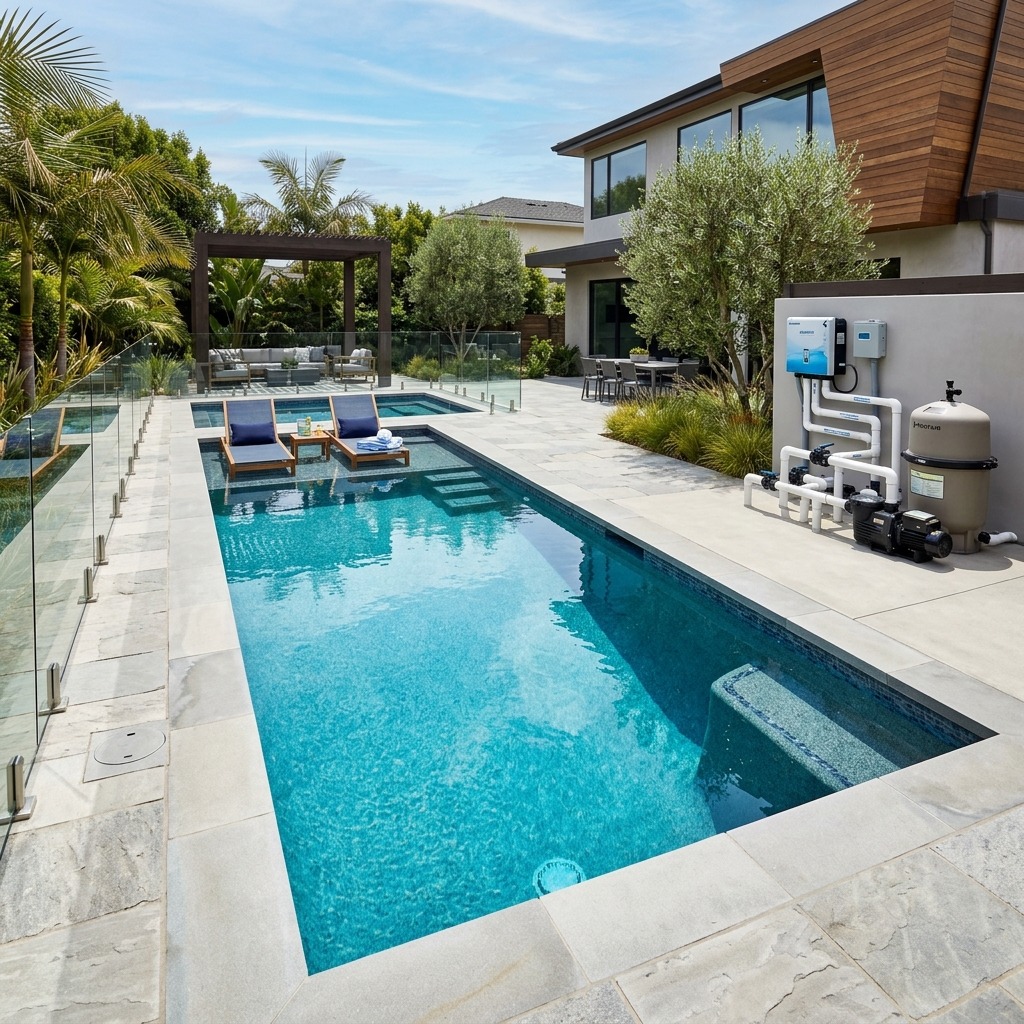
The circulation pump is the largest electricity consumer in your pool system. A single-speed 1.5 HP pump running 8 hours daily consumes approximately 3.6 kWh/day — roughly $175–$210/year at national average electricity rates. A variable-speed pump running the same daily cycle but at optimized speeds consumes 0.8–1.5 kWh/day — reducing annual pump electricity cost to $40–$75/year. Many states mandate variable-speed pumps for new pools; they cost $200–$500 more than single-speed units but pay back in 6–18 months of electricity savings.
Heating Costs ($100–$400/month seasonal)
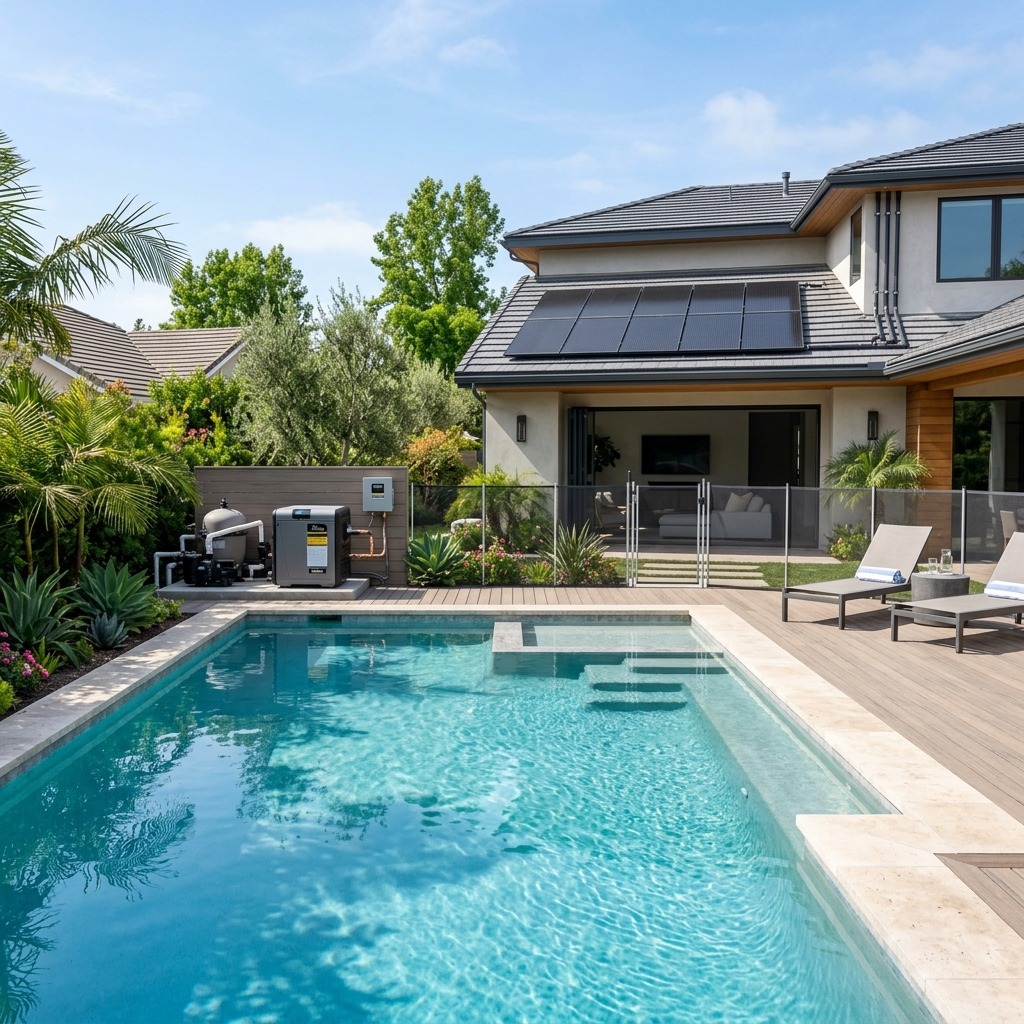
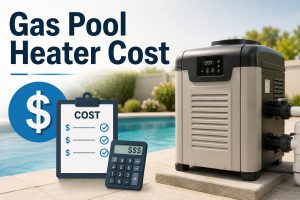
Pool heating is the highest-variable monthly cost, depending on fuel type, pool volume, target temperature, climate, and season length. Gas pool heaters cost $100–$300/month in operating months. Heat pump pool heaters (which use ambient air heat) cost $60–$180/month. Solar pool heating has near-zero operating cost after the $3,000–$8,000 system installation. See our pool decking and heating costs guide for full heating system comparison.
2. Chemical Breakdown What You’re Actually Buying Each Month
Chlorine & Shock Treatments
Chlorine is the primary sanitizer for most residential pools. It’s available in three main forms: trichlor tablets (slow-dissolving, 3-inch pucks commonly used in floating dispensers or chlorinators), dichlor granules (fast-dissolving, used for shock and spot treatment), and liquid sodium hypochlorite (high-strength liquid chlorine).
Tablet chlorine costs $0.60–$1.00 per pound when purchased in bulk (25–50 lb buckets). A standard 15,000-gallon pool consumes approximately 3–5 lbs of tablet chlorine per week during peak summer, costing $8–$20/week in chlorine alone. Shock treatments (weekly or biweekly) add another $5–$15/application in liquid or granule shock product.
pH Balancers, Algaecide & Stabilizer
pH management is the second-most important ongoing chemical task. Pools naturally drift acidic (low pH) from swimmer activity, rain, and chlorine products. Soda ash (sodium carbonate) raises pH; muriatic acid lowers it. Monthly pH chemical cost: $10–$25 depending on how aggressively pH drifts.
Algaecide is used preventively — a monthly dose prevents algae establishment far more cheaply than treating an active algae bloom (which requires 3–5× normal chlorine and often a professional service call). Monthly algaecide cost: $5–$12.
Cyanuric acid (stabilizer) protects chlorine from UV degradation. Without stabilizer, UV breaks down chlorine within hours of application. A properly stabilized pool (60–80 ppm cyanuric acid) maintains chlorine effectiveness significantly longer, reducing total chlorine consumption. Apply 1–2 times per season; cost $15–$40 per application.
Salt System vs. Chlorine System Costs
A salt chlorine generator (SCG) produces chlorine from dissolved salt in the pool water, eliminating the need to purchase and handle chlorine products. The system generates chlorine continuously as water passes through the electrolytic cell.
Salt system ongoing costs:
- Pool salt (50 lb bags): $8–$15/bag; add 1–3 bags per season to replace salt lost to splash-out and backwashing
- Cell replacement: $200–$600 every 3–7 years depending on usage and maintenance
- Electricity for cell: minimal addition to pump electricity
Salt system vs. chlorine comparison (annual):
- Traditional chlorine: $400–$900/year in chemical purchases
- Salt system chemicals: $50–$150/year in salt + $30–$100 prorated cell replacement cost
The salt system pays back its $1,500–$4,000 installation cost in chemical savings within 3–6 years for most pools. For a 10-year cost comparison across all maintenance approaches, our vinyl liner vs fiberglass pool true 10-year price analysis incorporates maintenance cost modeling.
3. Equipment Maintenance Schedule & Costs
Filter Cleaning & Cartridge Replacement
Pool filters remove particulates from the water and require regular maintenance to function effectively. Three filter types have different maintenance schedules:
Cartridge filters: Clean every 2–4 weeks (rinse with garden hose); replace cartridge every 1–3 years at $50–$200 per cartridge. Annual cost: $50–$200 in cartridge replacement, minimal in cleaning time.
Sand filters: Backwash (reverse flow to clean) every 1–2 weeks; replace sand every 5–7 years at $100–$300 per sand change. Annual cost: $15–$60 in sand replacement prorated.
D.E. (diatomaceous earth) filters: Backwash as needed; add D.E. powder after each backwash ($15–$25 per application, 4–8/year); full tear-down cleaning annually. Annual cost: $60–$200.
Pump Motor Life & Replacement Budget
A quality variable-speed pump has a typical lifespan of 10–15 years with proper maintenance. Single-speed pumps last 8–12 years. Replacement cost: $500–$1,500 for a standard pump; $800–$2,000 for a variable-speed unit. Prorating over 12 years: budget $40–$165/year in pump replacement reserve.
Pool heaters (gas) last 8–12 years; replacement cost $800–$2,500. Prorated annual cost: $70–$310. Heat pump heaters last 10–15 years; replacement cost $2,000–$5,000. Prorated annual cost: $130–$500.
Robotic Cleaner vs. Suction Cleaner Costs
Suction cleaners (connect to the skimmer line): $150–$600 upfront; 4–7 year lifespan; minimal operating cost. Annual cost: $25–$85 prorated.
Pressure cleaners (use dedicated booster pump): $300–$800 upfront + booster pump ($400–$700); 5–8 year lifespan. Annual total: $100–$200 prorated.
Robotic cleaners (independent electric unit): $800–$2,500 upfront; 4–7 year lifespan; $25–$50/year in electricity. Annual prorated cost: $140–$380. Robotic cleaners are more effective but costlier; they significantly reduce the professional service time required. For lap pool owners who use their pools intensively, the robotic option makes particular sense — see our lap pool cost calculator for lap-specific maintenance considerations.
4. Pool Resurfacing & Structural Maintenance
This is where pool type diverges most dramatically in long-term cost. Fiberglass pools have the lowest structural maintenance costs; concrete pools have the highest.
Vinyl Liner Replacement (7–10 years, $3,500–$7,000)
Vinyl liners fade, become brittle, and eventually crack or tear. Liner replacement is a predictable maintenance event for vinyl liner pool owners. The liner must be removed (old liner disposal), the walls and floor inspected for any structural issues (repairs if needed), and a new liner measured, cut, and installed. Full liner replacement including labor runs $3,500–$7,000 for a standard 14×28-foot pool in 2026. Budget $350–$700/year in liner replacement reserve. For a comprehensive 10-year cost comparison between vinyl and fiberglass, our fiberglass vs concrete pool cost comparison includes full structural maintenance modeling.
Fiberglass Gelcoat Repairs
Fiberglass pools rarely require major structural maintenance because the gelcoat surface is non-porous and highly resistant to staining, scaling, and chemical damage. When repairs are needed — stress cracks (spider cracks) from ground movement, impact damage, or osmotic blistering (rare) — they run $200–$1,500 per repair area. Most fiberglass pool owners incur no structural maintenance costs for 15–25 years with proper water chemistry.
Concrete Replastering (10–15 years, $5,000–$15,000)
Concrete pool plaster has a defined service life: standard white plaster lasts 10–12 years before developing rough texture, staining, and erosion that warrants replastering. Premium aggregate finishes (PebbleTec, Diamond Brite) last 18–25 years. Replastering a standard 14×28-foot pool costs $5,000–$12,000 for standard plaster; $10,000–$20,000 for premium aggregate. This is the largest single maintenance cost in pool ownership — and it’s non-negotiable. Budget $400–$1,000/year in replastering reserve for concrete pools.
5. Seasonal Opening & Closing Costs
Spring Startup Cost ($150–$500)
Opening a pool after winter involves: removing and storing the cover, reinstalling equipment that was winterized, refilling any water lost over winter, reconnecting plumbing lines, starting up the filtration system, and performing a comprehensive water chemistry adjustment (the spring opening chemical treatment often requires significant chemicals to rebalance a pool that’s been sitting for months). Professional opening service: $150–$350. DIY opening supplies: $80–$200 in chemicals.
Winterization Cost ($100–$400)
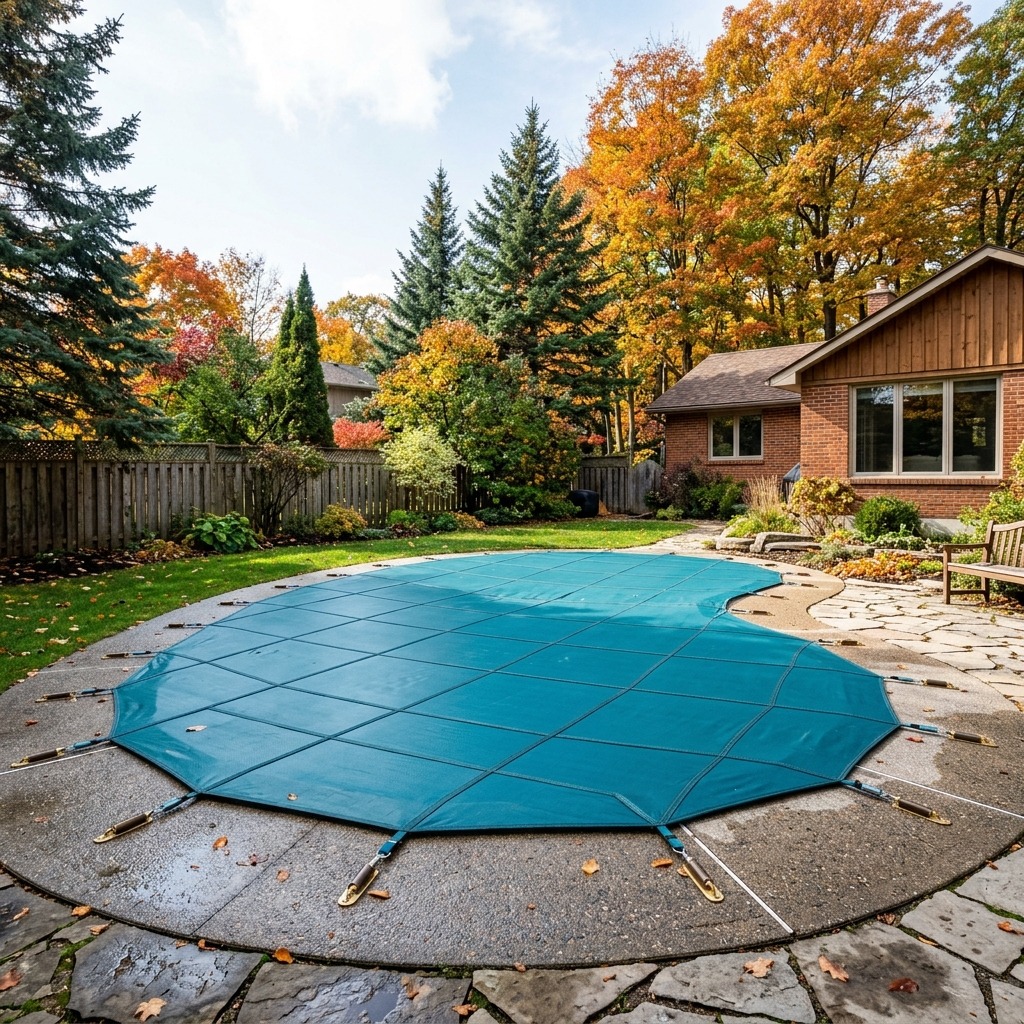
Properly closing a pool before winter prevents freeze damage to plumbing lines, equipment, and the pool shell. Winterization includes: lowering water level, blowing out all plumbing lines with compressed air, adding winter chemicals (algaecide, shock, freeze protection), plugging all returns and skimmers, and installing the winter cover. Professional winterization service: $150–$350. DIY winterization supplies: $80–$150 in chemicals plus any plug/cover costs.
6. Annual Maintenance Budget Calculator by Pool Type
| Pool Type | Annual Chemicals | Annual Electricity | Structural Reserve | Pro Service (Optional) | Annual Total |
| Above-Ground (frame) | $300–$600 | $180–$400 | $50–$150 | $600–$1,200 | $1,130–$2,350 |
| Vinyl Liner Inground | $500–$900 | $360–$800 | $350–$700 | $960–$2,400 | $2,170–$4,800 |
| Fiberglass Inground | $300–$600 | $360–$800 | $50–$200 | $960–$2,400 | $1,670–$4,000 |
| Concrete / Gunite | $700–$1,500 | $360–$800 | $400–$1,000 | $960–$2,400 | $2,420–$5,700 |
| Lap Pool (concrete) | $800–$1,800 | $480–$960 | $400–$1,000 | $1,200–$2,880 | $2,880–$6,640 |
| Indoor Pool | $600–$1,200 | $2,400–$5,000 | $400–$800 | $1,200–$2,880 | $4,600–$9,880 |
The cost of owning a pool does not stop after installation, thanks to daily chemical balancing and eventual wear and tear. If your plaster is showing its age, the pool resurfacing cost calculator will help you budget for the repair before it turns into a bigger job.
If you want to cut down on chemical costs long-term, check the salt water pool cost estimator to see if switching to a salt cell system is worth the upfront investment for your pool size.
7. DIY Maintenance vs. Hiring a Pool Service Full Cost Comparison
The financial case for DIY pool maintenance is clear in dollars: you avoid $960–$2,400/year in labor costs. The practical case depends on whether you’ll actually do it consistently.
DIY makes sense when:
- You’re willing to test water chemistry weekly and adjust as needed
- You can commit 30–60 minutes per week to physical pool maintenance tasks
- You understand pool chemistry (or are willing to learn)
- You have the storage space for chemicals and equipment
Professional service makes sense when:
- You travel frequently and can’t maintain a consistent schedule
- You’ve had recurring algae problems that suggest inconsistent DIY chemistry management
- Your pool is in heavy use during summer and requires more frequent attention
- The time cost of maintenance is higher value to you than the service fee
The hybrid approach — testing and adjusting chemistry yourself, with monthly professional visits for deep cleaning and equipment checks — often provides the best cost-efficiency: $40–$80/month in professional visits versus $80–$200/month for full weekly service.
Conclusion
Pool ownership costs don’t end when the construction crew leaves. Every pool carries a monthly financial commitment for chemicals, electricity, and professional services — plus a long-term reserve for equipment replacement and structural renewal. The good news is that these costs are entirely predictable and plannable. With the right budget established before you build, there are no surprises.
Use the table in Section 6 to build your pool-type-specific annual maintenance budget. Factor that annual cost into your decision between pool types — the lower maintenance cost of fiberglass versus concrete, for example, directly affects which build cost you can actually afford to own long-term.
Ready to run the numbers for your specific project? Use the tools at PoolCostEstimator.com to model construction cost, ownership cost, and the complete financial picture of your pool project — then contact us to connect with vetted local contractors for qualified quotes.
Frequently Asked Questions
How much does it cost to maintain a pool per month?
DIY pool owners typically spend $100–$200/month in chemicals, electricity, and supplies during the swimming season. Adding professional weekly service raises the total to $200–$400/month. Heating adds another $100–$400/month in operating months.
Is a fiberglass pool cheaper to maintain than concrete?
Yes, significantly. Fiberglass pools cost 30–50% less in annual chemicals due to the non-porous gelcoat surface, and they rarely require the major replastering events that concrete pools need every 10–15 years. Over a 20-year ownership period, the maintenance cost advantage of fiberglass over concrete is $15,000–$40,000 depending on pool size.
How do I reduce my pool’s electricity costs?
Install a variable-speed pump if you don’t already have one — this single change reduces pump electricity by 50–80%, saving $150–$500/year. Run the pump during off-peak electricity hours where time-of-use billing applies. Install a timer or automation system to prevent the pump running unnecessary hours.
What causes most pool maintenance emergencies?
Algae blooms from inconsistent chemical management (the most common), equipment failure from deferred maintenance, and liner or surface damage from improper water chemistry (pH and calcium hardness out of range). All of these are preventable with a consistent weekly routine.
How much should I budget for equipment replacement over 20 years?
For a typical inground pool, budget $8,000–$20,000 over 20 years for cumulative equipment replacement (2–3 pumps, 1–2 filters, 1–2 heaters, 2–3 cleaners). This averages $400–$1,000/year in equipment replacement reserve.
Is a saltwater pool cheaper to maintain than chlorine?
In ongoing chemical costs, yes — salt costs roughly $50–$150/year vs. $400–$900/year for chlorine products. The salt cell requires replacement every 3–7 years at $200–$600. Net savings over 10 years: $2,000–$5,000 after accounting for cell replacements and the initial system installation cost.
How often should pool water be professionally tested?
Monthly professional testing is recommended even for DIY maintainers — at-home test strips and basic kits don’t measure all relevant parameters (total dissolved solids, phosphates, stabilizer levels). A full professional water analysis typically runs $10–$30 at a pool supply store.
What’s the most expensive pool maintenance mistake homeowners make?
Letting algae establish because of irregular chemical management. A green pool recovery — draining or triple-shocking, scrubbing, running the filter continuously for 24–72 hours, and restoring water chemistry — costs $200–$600 in chemicals and professional time. The $150/month in consistent chemical management would have prevented it entirely.