Vinyl liner pools consistently rank among the most purchased inground pool types in the United States and the reason is simple: they deliver a smooth, attractive swimming surface at the lowest day-one cost of any inground build. But that entry-price advantage comes attached to a deferred cost most buyers never see in the initial quote the liner replacement cycle.
This guide breaks down every layer of the vinyl pool cost equation, from the day-one installation quote through 15 years of ownership, so you can make a fully informed decision before you sign a single contract.
Key Takeaways
- Vinyl liner pools cost $35,000–$65,000 to install the lowest upfront price of any inground pool type.
- Full liner replacement costs $6,200–$12,500 every 5–9 years, making it the largest hidden recurring expense.
- 28-mil virgin vinyl liners last 40% longer than standard 20-mil liners; the upgrade almost always pays for itself in extended cycle life.
- Annual maintenance runs $1,510–$3,860/year (DIY) or $1,990–$4,860/year (professional service) depending on climate and service level.
- Over 10 years, a vinyl pool’s total cost of ownership is roughly $80,000–$92,000 significantly lower than concrete, and comparable to fiberglass after the first liner replacement cycle.
- Frame material matters: polymer composite wall panels far outlast steel panels in humid, coastal, and high-chlorine environments, and carry stronger lifetime warranties.
How Vinyl Pools Are Built
Before comparing price tags, it helps to understand exactly what you’re buying.
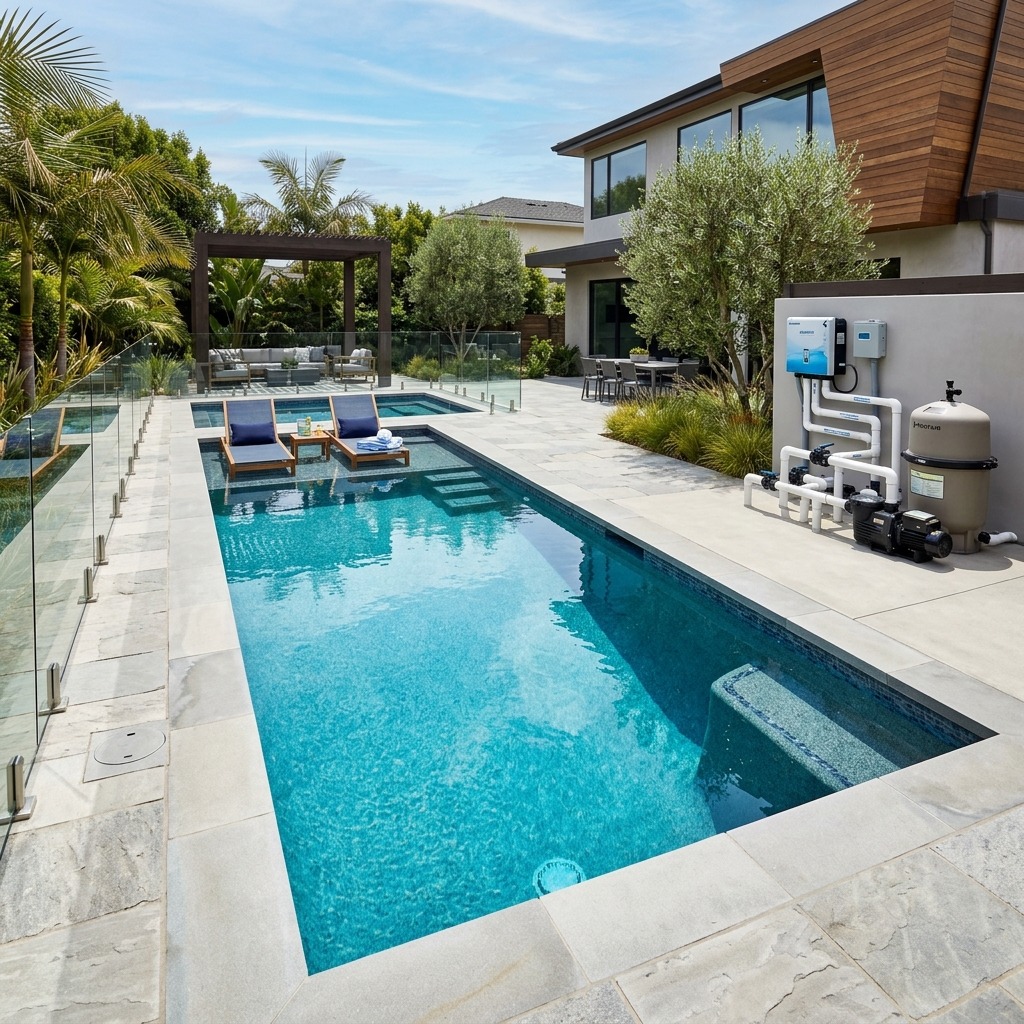
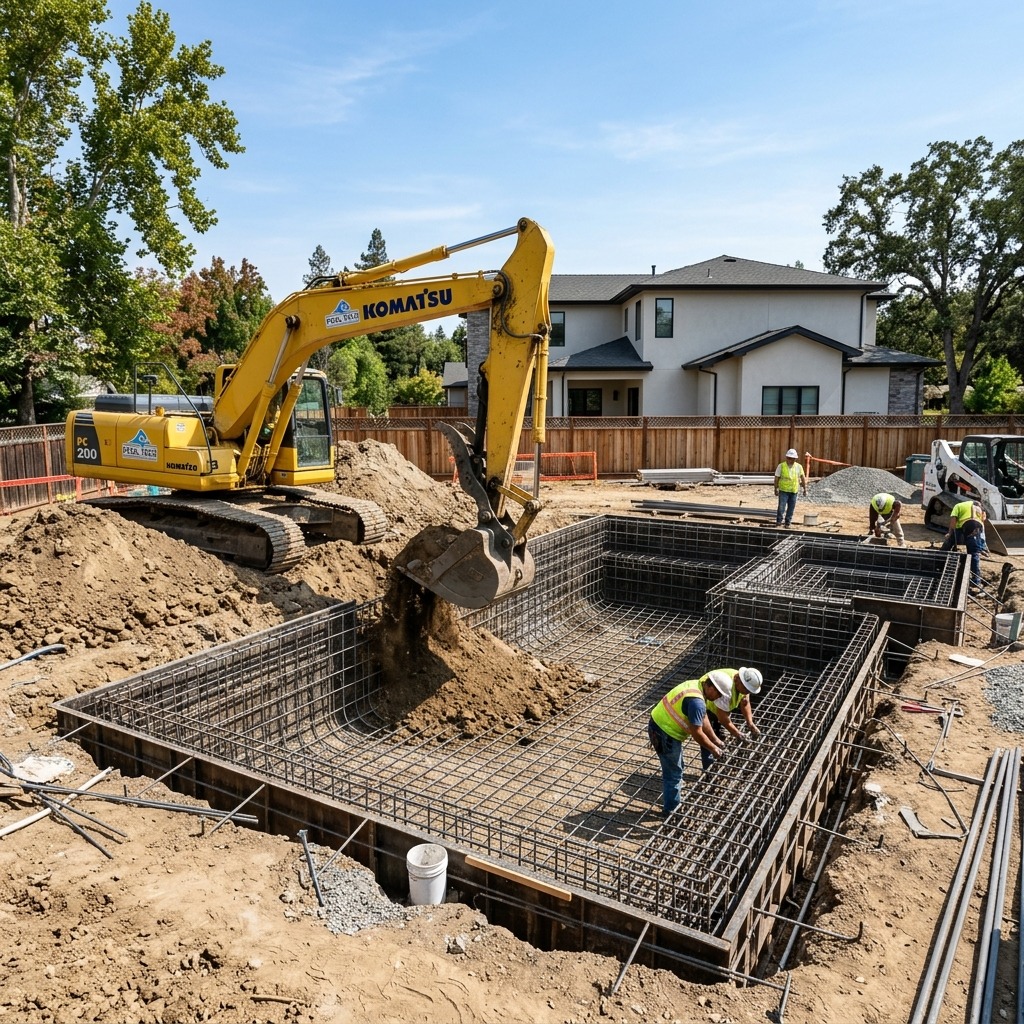
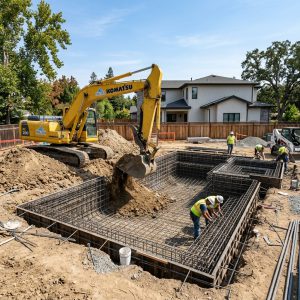
A vinyl liner pool is a framed structure. The pool’s shape is formed by a series of wall panels made from steel, aluminum, or high-density polymer assembled in the excavated hole and anchored to a concrete bond beam at the top edge. The floor is covered with a layer of vermiculite (a crushed mineral compound mixed with portland cement) or sand, which forms a smooth, compactable sub-surface. The vinyl liner itself, a thermoplastic sheet custom-fitted to your pool’s exact dimensions is then draped over the frame and floor, seated into a bead track or J-channel at the top of the walls. Water weight presses the liner tight against the walls and floor, keeping it taut during normal operation.
The critical distinction that drives all long-term cost decisions: the liner is a replaceable consumable. It is not a structural element of the pool, it is a surface coating stretched over the real structure. When it degrades, tears, or fails, you don’t replace the pool. You replace the liner. That replacement cycle and its full cost is what separates vinyl pool ownership from every other inground pool type.
During pool commissioning and seasonal startup, installation technicians verify the vermiculite-portland cement floor compound is uniformly compacted using a digital vinyl liner vacuum installation manifold a tool that draws a calibrated negative-pressure vacuum behind the liner during seating to eliminate air pockets and ensure full contact with the floor substrate. Uneven floor contact is the leading cause of early wrinkle formation. Floor flatness tolerances under ANSI/APSP-7 Standard Practice for Residential Inground Swimming Pools Section 5.3.4 require the pool floor to be within ½ inch of planned grade across any 10-foot span before the liner is set.
Full Installation Cost Breakdown (2026)
Here is a complete, line-by-line breakdown of what a vinyl liner pool costs to build in 2026:
| Cost Component | Low Range | High Range | Notes |
| Excavation & Dirt Hauling | $3,000 | $7,000 | Rock excavation adds $2,000–$8,000 |
| Wall Panels (steel) | $3,000 | $6,000 | Standard; shorter lifespan in humid climates |
| Wall Panels (polymer composite) | $5,000 | $9,000 | Rust-proof; strongly recommended |
| Vermiculite-Portland Floor | $1,500 | $3,500 | Superior to sand for liner longevity |
| Vinyl Liner (20-mil standard) | $2,500 | $4,000 | Budget option; 5–7 year lifespan |
| Vinyl Liner (28-mil premium) | $3,800 | $6,500 | Recommended; 8–12 year lifespan |
| Plumbing (skimmers, returns, main drain) | $2,500 | $5,500 | More return jets = better circulation |
| Filtration Equipment (pump, filter) | $4,000 | $9,000 | Variable-speed pump is worth the upgrade |
| Electrical & Bonding Grid | $1,500 | $3,500 | Required by code in every state |
| Basic Concrete Deck (300 sq ft) | $3,500 | $7,000 | Pavers/stamped concrete cost more |
| Pool Permit & Inspections | $400 | $2,500 | Varies widely by state and county |
| Total (Standard Build) | $35,000 | $55,000 | Polymer panels + 28-mil liner |
| Total (Premium Build) | $55,000 | $65,000 | Upgraded equipment + custom deck |
Contractor Tip: Always ask whether your quote includes a 20-mil or 28-mil liner and whether the wall panels are steel or polymer composite. These two choices are almost never spelled out in base quotes and they determine your liner replacement schedule for the next decade.
The pool’s bonding grid, a continuous copper wire network connecting all metal components and the pool water is a non-negotiable code item, not an optional upgrade. After installation, contractors verify bonding circuit continuity using a pool equipotential bond continuity tester, an instrument that measures resistance across each metal bond point to confirm the bonding grid meets the zero-resistance standard required under NEC Article 680.26(B)(1), which mandates equipotential bonding for all in-ground pool structures to eliminate shock hazard from stray current in the water.
Cost Factors That Move the Price Up or Down
Pool Size & Shape
Size is the single biggest driver of vinyl pool installation cost. Every additional foot of pool length adds excavation volume, more wall panels, a larger liner, more plumbing, and more equipment runtime.
| Pool Size | Approximate Installed Cost |
| 12 × 24 ft (small) | $35,000 – $48,000 |
| 14 × 28 ft (mid-size) | $42,000 – $55,000 |
| 16 × 32 ft (standard) | $48,000 – $62,000 |
| 16 × 36 ft (large) | $55,000 – $68,000 |
| 18 × 36 ft (resort-style) | $62,000 – $78,000 |
Pool shape also adds cost. Rectangular pools are the most affordable to build in vinyl, the liner is simpler to manufacture and the wall panels are standard. Freeform or curved designs require specialty liner fabrication and non-standard panel configurations, adding $3,000–$8,000 to the base installation.
Depth
Standard vinyl pools are built with a shallow end of 3–3.5 feet and a deep end of 5–6 feet. If you want a true 8-foot diving well, the excavation deepens significantly, the walls get taller, and the liner is larger, plan for an additional $4,000–$9,000 on top of the base build cost.
Diving well depth verification is performed using an ANSI/NSPI-5-rated depth gauge rod, a calibrated measurement instrument that establishes minimum water depth at the point of entry and along the underwater trajectory arc required for safe diving. ANSI/NSPI-5 Section 6.9 specifies minimum water depth requirements for diving board configurations: a minimum 7.5 feet at the point directly below the board tip and a defined underwater clearance envelope that determines whether your pool’s actual excavated depth supports a diving board or not. Homeowners who discover post-construction that their pool depth doesn’t meet the ANSI/NSPI-5 envelope face the choice of removing the board or expensive re-excavation.
Wall Panel Material: Steel vs. Polymer
Steel panels are galvanized and coated, but are still vulnerable to rust at connector joints especially in humid climates, coastal areas, or pools with chronically low pH. A steel panel pool can develop corrosion issues within 8–15 years. If corrosion reaches the bond beam, structural repair is expensive.
Polymer composite panels (manufactured by brands including Latham Pool Products, Merlin Industries, and GLI Pool Products) are completely rust-proof. They expand and contract with temperature changes without cracking, require zero structural maintenance, and typically carry lifetime manufacturer warranties. The premium over steel panels is $1,500–$3,000 one of the most clearly justified long-term value upgrades in vinyl pool construction.
Recommendation: Choose polymer composite panels. The upfront cost difference is modest relative to the total project cost, and it eliminates one of the most expensive mid-ownership repair scenarios entirely.
Add-Ons & Upgrades
| Add-On | Typical Cost |
| Salt Water Chlorine Generator | $1,200 – $2,500 installed |
| Variable-Speed Pump Upgrade | $400 – $900 over standard pump |
| LED Underwater Lighting | $800 – $2,000 |
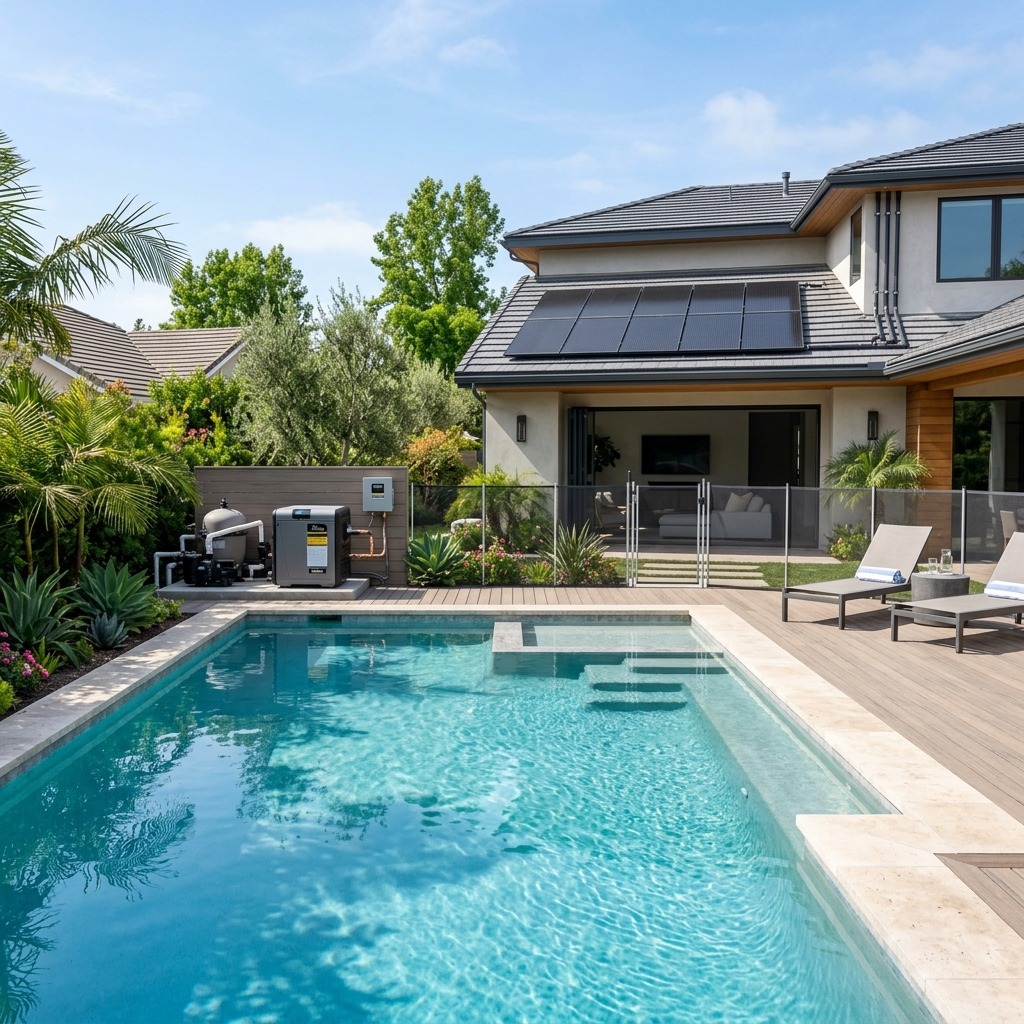
| Pool Heater (gas) | $2,500 – $4,500 installed |
| Heat Pump | $3,000 – $6,500 installed |
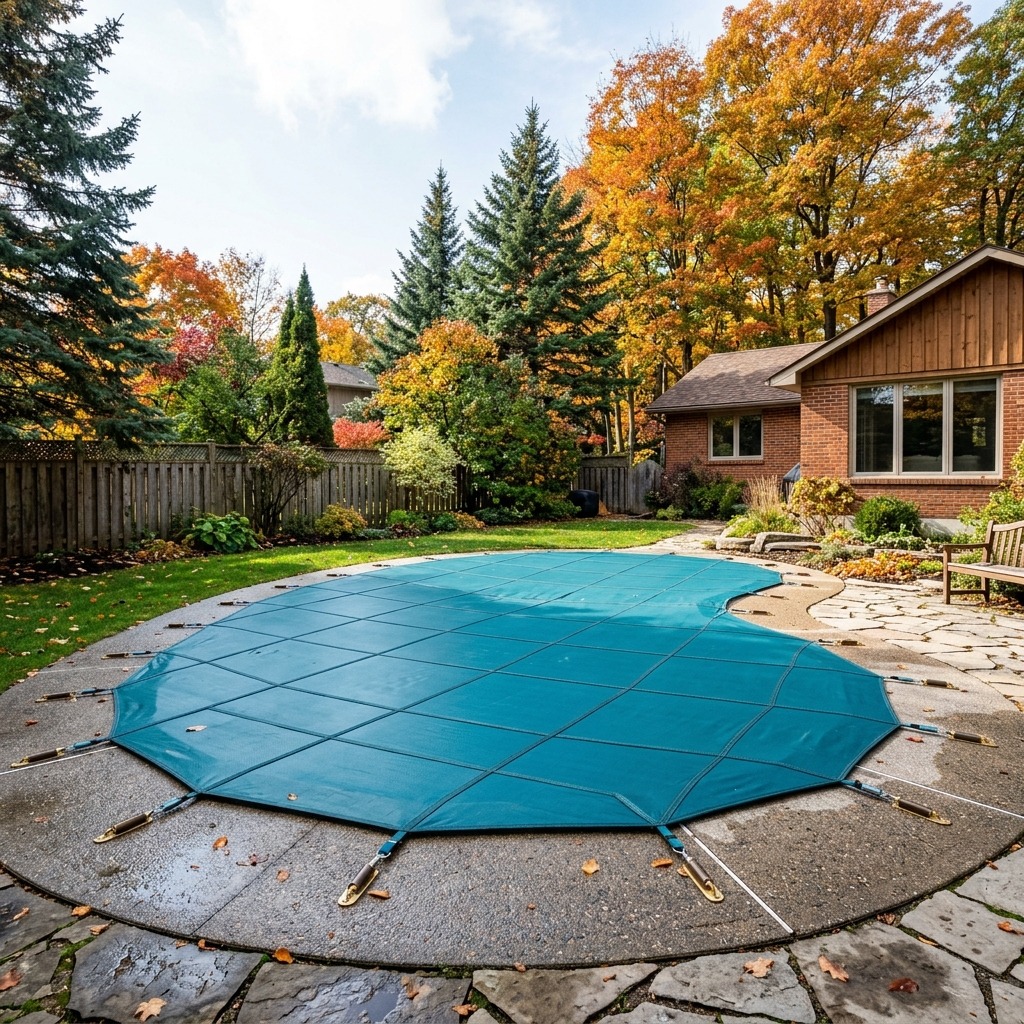
| Automatic Safety Cover | $8,000 – $15,000 |
| Integrated Spa | $12,000 – $25,000 additional |
| Concrete Deck Upgrade (pavers) | $6,000 – $20,000+ |
| Waterfall / Water Feature | $2,000 – $10,000 |
Liner Thickness: The 20-Mil vs. 28-Mil Decision
This single specification will determine your liner replacement timeline and your out-of-pocket costs for the entire life of your pool.
20-Mil Liner (Standard / Budget)
A 20-mil liner is 0.020 inches thick roughly the equivalent of four sheets of printer paper stacked together. It is the industry baseline and is included in virtually every competitive base quote. Under normal conditions with balanced water chemistry and no pets, a 20-mil liner lasts 4–7 years.
28-Mil Liner (Premium)
A 28-mil liner is 40% thicker. It is meaningfully more resistant to:
- Tears from pool steps, toys, and pet claws
- UV degradation at the waterline
- Wrinkle formation from water absorption
- Bead track stress at the liner’s upper edge
A well-maintained 28-mil liner in a chemically balanced pool typically lasts 7–12 years. The price difference $1,300 to $2,500 more at installation almost always pays for itself by pushing your first liner replacement 3–5 years further out.
Virgin Vinyl vs. Recycled Content
Budget liners are sometimes manufactured using recycled vinyl compound, which has inconsistent plasticizer levels and lower UV resistance. Always specify “virgin vinyl” in writing when ordering made entirely from new resin, virgin vinyl maintains elasticity and color consistency significantly longer than recycled content alternatives.
The Math on Liner Upgrades
If a 20-mil liner lasts 6 years and a 28-mil liner lasts 10 years, the 28-mil liner saves you one full liner replacement cycle over 20 years of pool ownership. At $6,200–$12,500 per replacement (full cost see next section), that’s a return of 4x–8x on the $1,500 upgrade cost.
Liner flexibility and hardness are verified during quality acceptance using a digital shore A durometer, a hand-held instrument that measures surface hardness of the vinyl compound in ASTM durometer units. Readings above 85 Shore A indicate over-plasticized or recycled-content vinyl that will become brittle under UV exposure faster than specified. The standard for premium residential pool liners is a Shore A hardness reading of 78–82, per ASTM D2240 Standard Test Method for Rubber Property — Durometer Hardness, which governs elastomeric surface material hardness measurement for pool liner quality verification.
Liner Replacement: The Full True Cost
Liner replacement is the defining long-term cost variable of vinyl pool ownership and it is almost always larger than homeowners expect when they first budgeted for their pool.
What the Replacement Process Involves
When a liner fails whether from UV degradation, pet damage, algae etching at seams, or bead track slippage the full replacement sequence is:
- Pool draining — 18,000–25,000 gallons must be removed via submersible pump. Cost: $150–$400 in pump rental or electricity.
- Liner removal — The old liner is cut away from the bead track, removed, and disposed of.
- Floor inspection and repair — The vermiculite-portland cement floor is inspected for voids, washout, or erosion. Floor repairs: $500–$2,500.
- Wall panel inspection — Corrosion on any steel panels is treated or replaced at this stage. Panel replacement: $800–$3,000 per section.
- New liner manufacturing — A custom liner is measured and ordered. Lead time: 3–5 weeks.
- New liner installation — Professional vacuum-fit installation: $1,500–$2,500 in labor.
- Pool refill — Refilling a 20,000-gallon pool: $100–$300 via municipal water, $800–$2,000 via water delivery truck.
- Water chemistry startup — Full chemical rebalancing of fresh water: $150–$300 in chemicals.
Full Liner Replacement Cost Summary
| Component | Low | High |
| New 28-mil virgin vinyl liner (custom) | $3,800 | $6,500 |
| Labor (professional installation) | $1,500 | $2,500 |
| Pool drainage | $150 | $400 |
| Floor inspection & repair | $500 | $2,500 |
| Water refill & chemical startup | $250 | $600 |
| Total Replacement Cost | $6,200 | $12,500 |
Budget Conservatively: Most vinyl pool owners budget $7,000–$9,000 for a full premium liner replacement cycle, accounting for floor repairs and chemical startup that are rarely included in online “liner cost” estimates you’ll find elsewhere.
During the fresh-water fill and chemical startup phase after liner replacement, water chemistry is calibrated using an amperometric chlorine sensor an electrochemical probe that measures free chlorine concentration in parts per million with laboratory-grade precision, compared to the ±0.5 ppm error tolerance of standard DPD test strips. Maintaining free chlorine within the 1.0–3.0 ppm band specified under CDC Model Aquatic Health Code (MAHC) Section 5.7.3.1 is critical immediately after liner installation hypochlorination (below 0.5 ppm) allows algae to colonize liner seams within days, while hyperchlorination (above 5.0 ppm sustained) accelerates vinyl plasticizer leaching and causes premature liner brittleness.
Ready to calculate your liner replacement timeline? Use our vinyl pool cost calculator to model your specific pool size and liner grade against the 10-year cost curve before you sign your installation contract.
Annual Maintenance Costs
DIY vs. Professional Service
| Category | DIY Monthly | Pro Service Monthly |
| Chemicals (chlorine, pH, algaecide, stabilizer) | $50 – $120 | Included in service fee |
| Professional service (weekly visits) | — | $90 – $200 |
| Electricity (pump & filter) | $30 – $80 | Same |
| Seasonal heating (gas or heat pump) | $100 – $400 | Same |
| Equipment maintenance reserve | $25 – $60 | Same |
| Monthly Total | $205 – $660 | $295 – $740 |
Annual Breakdown
| Annual Cost Category | DIY Annual Range |
| Pool chemicals (chlorine, shock, pH, algaecide) | $600 – $1,400 |
| Electricity (pump operation) | $360 – $960 |
| Seasonal opening & closing | $250 – $700 |
| Equipment maintenance reserve (prorated) | $300 – $800 |
| Total Annual (DIY) | $1,510 – $3,860 |
| Annual Cost Category | Professional Annual Range |
| Professional service (chemicals included in fee) | $1,080 – $2,400 |
| Electricity (pump operation) | $360 – $960 |
| Seasonal opening & closing | $250 – $700 |
| Equipment maintenance reserve (prorated) | $300 – $800 |
| Total Annual (Professional) | $1,990 – $4,860 |
Note: Professional pool service fees include the cost of chemicals. Do not add the DIY chemical line item on top of a professional service contract that results in double-counting.
Chemical Notes Specific to Vinyl Pools
Vinyl liners are sensitive to chemical extremes in both directions:
- Hypochlorination (below 0.5 ppm) allows algae to colonize liner seams and micro-perforations, causing irreversible staining and accelerating material breakdown.
- Hyperchlorination (above 5.0 ppm sustained) bleaches the liner’s printed pattern and accelerates plasticizer leaching, causing the liner to become brittle and crack-prone over time.
- Low pH (below 7.0) is the most damaging condition because acidic water actively degrades the vinyl polymer and causes liner wrinkling that cannot be reversed.
- Salt systems are compatible with most vinyl liner pools, but require verification that your liner, fittings, and wall panels carry saltwater compatibility ratings before conversion.
Total dissolved solids (TDS) the cumulative concentration of all dissolved minerals and chemicals in the pool water climbs more rapidly in vinyl pools than in fiberglass pools because vinyl seams can harbor dissolved organics. Service technicians measure TDS using a TDS conductivity meter, a probe instrument that estimates dissolved ion concentration by measuring the water’s electrical conductance in microsiemens per centimeter. Readings above 1,500 ppm trigger a partial drain-and-refill protocol under the guidelines established by the Pool and Hot Tub Alliance (PHTA) Technical Manual Section 7.2, which sets TDS management thresholds for residential pool water quality high TDS interferes with chlorine efficacy and accelerates corrosion of return fittings and bonding hardware.
Equipment Replacement Reserve
Budget these costs on a prorated annual basis:
| Equipment Item | Lifespan | Replacement Cost | Annual Reserve |
| Variable-speed pump | 10 – 15 years | $800 – $2,000 | $65 – $160 |
| Filter (cartridge) | 7 – 10 years | $400 – $900 | $45 – $100 |
| Pool heater (gas) | 8 – 12 years | $2,000 – $4,500 | $185 – $465 |
| Heat pump | 10 – 15 years | $3,000 – $6,500 | $215 – $480 |
| Robotic cleaner | 4 – 7 years | $800 – $2,500 | $130 – $450 |
| Salt cell (if applicable) | 3 – 7 years | $200 – $600 | $35 – $130 |
Regional Price Variations by State
Vinyl pool installation costs vary significantly by region. The following 2026 market estimate ranges apply to a standard 16×32-foot vinyl liner pool with polymer composite panels and a 28-mil liner, including basic concrete deck. These reflect regional labor rates, permit costs, and material freight variances not contractor survey data.
| Region / States | Installed Cost Range |
| Southeast (FL, GA, SC, AL, MS) | $38,000 – $54,000 |
| Southwest (TX, AZ, NM, NV) | $42,000 – $58,000 |
| Midwest (IL, OH, IN, MN, MO) | $44,000 – $60,000 |
| Mid-Atlantic (VA, MD, PA, NJ) | $48,000 – $65,000 |
| New England (MA, CT, NY) | $52,000 – $72,000 |
| Mountain West (CO, UT, WA, OR) | $50,000 – $70,000 |
| California (various metro areas) | $58,000 – $82,000 |
Why such variation? Labor rates, material freight, permit fees, and seasonal demand all drive regional differences. A pool contractor in rural Alabama operates at a fundamentally different cost structure than one in coastal California and that difference flows directly into your quote.
Regional installation costs are also shaped by local soil conditions, which affect excavation complexity and the bonding grid design. Soil resistivity the measure of how strongly a soil resists electrical current is assessed using a four-pin soil resistivity meter (Wenner array configuration), an instrument that injects a low-frequency current between four equally spaced electrodes driven into the ground and measures the voltage drop to calculate resistivity in ohm-centimeters. High-resistivity soils (above 10,000 ohm-cm), common in desert Southwest markets, require expanded copper bonding grid layouts to meet the equipotential bonding requirements of NEC Article 680.62(A) which mandates that all permanently installed pools maintain a bonding grid adequate to eliminate dangerous voltage gradients in the soil surrounding the pool structure.
Vinyl vs. Fiberglass vs. Concrete: 10-Year Cost Comparison
The most valuable way to evaluate vinyl pool cost is to compare it against the alternatives across a full ownership horizon. The table below projects all predictable costs over 10 years for a standard 16×32-foot pool:
| Cost Category | Vinyl Liner Pool | Fiberglass Pool | Concrete Pool |
| Initial Installation | $52,000 | $68,000 | $80,000 |
| Liner Replacement (yr 7, 28-mil) | $7,500 | $0 | $0 |
| Concrete Replastering | $0 | $0 | $11,000 |
| Acid Washing (concrete, 2 cycles) | $0 | $0 | $2,400 |
| Annual Chemicals (10 yrs) | $8,000 | $4,500 | $12,000 |
| Electricity — Pump (10 yrs) | $7,000 | $4,000 | $6,500 |
| Routine Cleaning & Service (10 yrs) | $4,500 | $3,500 | $5,000 |
| Floor Repairs (liner replacement yr) | $1,200 | $0 | $0 |
| 10-Year Total Investment | $80,200 | $80,000 | $116,900 |
Key takeaways from this comparison:
- Vinyl vs. Fiberglass are nearly identical over 10 years; vinyl’s $16,000 lower install cost is almost entirely offset by the liner replacement cycle. By year 15+, fiberglass pulls ahead decisively as a second liner replacement hits vinyl pool owners.
- Vinyl vs. Concrete — vinyl wins clearly. Concrete’s replastering cycle, triple chemical demand, and higher electricity costs add $35,000–$40,000 over the same decade.
- For 10-year ownership or less, vinyl is the financially smart choice for budget-constrained buyers. For 15+ year ownership, fiberglass’s lifetime gelcoat surface becomes the superior investment.
Water chemistry comparison is verified using a digital photometer colorimeter, an optical instrument that measures the spectral absorbance of chemical reagents at precise nanometer wavelengths, delivering ±0.01 ppm chlorine resolution versus the ±0.5 ppm error of visual test strips. Consistent use of colorimeter-grade testing across a pool’s service life enables early detection of pH drift that degrades vinyl liner surfaces, fiberglass gelcoat, and concrete plaster at different rates, a key operational variable in validating the cost projections in the table above. Colorimeter measurement procedures comply with ANSI/APSP-16 — American National Standard for Fiberglass Pools and Spas, which includes water quality tolerance requirements used as a baseline for cross-pool-type chemistry comparison.
See your personal numbers: Use our vinyl pool cost calculator to input your pool size and get a side-by-side 10-year estimate. Or compare directly with the fiberglass pool cost calculator if fiberglass is still on the table.
Common Mid-Cycle Failure Costs
These are the unexpected repair bills that arrive between scheduled liner replacements:
Bead Track Slippage
The liner’s top edge seats into a J-channel receiver built into the wall panel coping. In warm weather, vinyl expands and can pull out of the bead track in sections, allowing the liner to drop away from the wall and creating an air pocket. Relocking repair: $200–$600. If the bead track itself is degraded and requires replacement: $800–$2,500.
Wrinkle Formation
Wrinkles develop when the liner absorbs water through micro-perforations and loses its elastic memory. Small wrinkles are cosmetic. Large wrinkles trap debris, harbor bacteria, and signal that the liner has permanently stretched beyond its design to fit a precursor to bead track failure. Partial repair (if possible): $150–$400. If wrinkles are extensive, early full replacement is typically more cost-effective than continued patching.
Pet Claw Punctures
Dog claws, particularly large breeds, can puncture standard 20-mil vinyl in a single forceful launch from the pool wall. Small punctures can be patched underwater with vinyl adhesive patches. Per puncture patch: $20–$80 DIY, $150–$350 professional. Multiple punctures accelerate overall liner degradation significantly.
Leak Detection & Repair
A pool losing more than ¼ inch of water per day (beyond normal evaporation) has an active liner or plumbing leak. Professional leak detection: $300–$800 for a full diagnostic. Repair costs:
- Small liner tear or puncture: $200–$500
- Skimmer gasket failure: $300–$700
- Return jet fitting leak: $400–$900
- Underground plumbing repair: $1,500–$8,000 (excavation required)
Steel Panel Corrosion Repair
For pools built with steel wall panels, corrosion at connector joints is an eventual maintenance issue. Early-stage rust treatment and recoating: $400–$1,200. Structural panel section replacement: $800–$3,500 per section. Polymer composite panels from manufacturers like Latham, Merlin, or GLI essentially eliminate this cost category entirely, the strongest argument for the upgrade at the time of build.
When diagnosing suspected liner leaks, technicians introduce a portable pH electrode dye tracer kit an instrument that injects a pH-reactive dye solution near suspected leak points and measures pH gradient migration in the water column using a calibrated glass electrode, allowing precision isolation of leaking seam regions without full pool drainage. The dye tracer diagnostic technique complies with ASTM D1293 — Standard Test Methods for pH of Water, which governs the measurement accuracy requirements for pH electrode instruments used in aquatic diagnostic applications, ensuring the colorimetric migration pattern observed is attributable to the leak pathway rather than instrument error.
Warranty: What’s Covered and What Isn’t
Vinyl pool warranties are structured very differently from fiberglass warranties understanding the distinction prevents expensive surprises during ownership.
Wall Panel Warranties
- Steel panels: Typically 20 years to lifetime against rust perforation but frequently voided if pool water chemistry falls outside specified pH ranges for extended periods. If the steel corrodes due to low pH operation, the manufacturer can deny the claim on chemistry-damage grounds.
- Polymer composite panels: Lifetime structural warranty, generally with fewer chemistry-related exclusions than steel panel warranties. However, most polymer panel warranties still exclude damage from improper installation, ground movement, and freeze-induced stress fractures that always read the specific manufacturer document before installation.
Vinyl Liner Warranties
Most liners carry a 5–10 year prorated manufacturer warranty. “Prorated” means the warranty payout decreases every year:
- Year 1: 100% coverage
- Year 3: ~70% coverage
- Year 5: ~40% coverage
- Year 7: ~10–20% coverage
By the time most 20-mil liners fail (around year 5–7), the warranty covers only a fraction of the replacement cost. Common warranty exclusion grounds: UV fading, chemical damage, physical punctures, and improper installation. Always request the liner warranty document from your contractor before installation not after.
Equipment Warranties
Most pumps, filters, and heaters carry 1–5 year manufacturer warranties. Salt cells: 2–5 years. LED lights: 2–5 years. Automatic safety covers: 3–7 years on the mechanism, 3–5 years on the fabric.
During warranty evaluation for suspected structural wall panel defects, inspectors locate and test the embedded metal bond wire running through the panel assembly using a magnetic bond wire continuity locator a passive magnetic field detector that traces the routing of the copper bonding conductor within the panel wall without requiring panel removal. Verifying that the bond wire is continuous and properly routed to the bond lug establishes structural manufacturing compliance as a prerequisite for warranty claim validity under ANSI/NSPI-5 Section 8.2 inspection criteria for vinyl liner pool structural wall assembly, which defines the acceptance standards for factory-manufactured pool wall panels.
Is a Vinyl Pool Right for You?
Choose Vinyl If:
- Budget is your primary driver. Vinyl delivers the most pool per dollar at installation no other inground pool type matches its entry price.
- You plan to stay in your home for 10 years or fewer. The liner replacement cycle may not hit you on a shorter ownership timeline.
- You want complete design flexibility. Unlike fiberglass shells (limited to pre-manufactured shapes up to 16 feet wide), vinyl liner pools from builders like Latham and Merlin can be constructed in virtually any shape, size, or depth configuration.
- You have pets but are prepared to upgrade to a 28-mil virgin vinyl liner and accept more frequent liner surface inspections.
- You’re in a cold climate. Vinyl pools winterize extremely well and don’t have the structural expansion/contraction concerns that affect some fiberglass shells in severe freeze-thaw environments.
Consider Fiberglass Instead If:
- You plan to stay 15+ years. The second liner replacement cycle is where fiberglass consistently wins the total cost comparison by $7,000–$15,000 or more.
- You want the lowest long-term chemical costs. Fiberglass gelcoat uses 30–40% fewer chemicals per season than vinyl or concrete.
- You want a true lifetime surface. Quality fiberglass gelcoat from manufacturers like Latham Fiberglass or Leisure Pools can last 25–35 years without structural replacement.
- You have pets that swim daily. Fiberglass gelcoat is essentially impervious to claw damage.
Consider Concrete Instead If:
- You want a fully custom shape complex curves, integrated grottos, beach entries, or pools wider than 16 feet that fiberglass manufacturing constraints can’t accommodate.
- You’re building a resort-style pool with extensive water features requiring custom-formed shells and intricate hydraulic systems.
Equipment pad ventilation for all three pool types is evaluated at commissioning and annual service using an anemometer air-velocity meter, a handheld instrument that measures airflow in feet per minute through equipment enclosure vents. Inadequate ventilation in enclosed pump and heater compartments accelerates motor winding overheating and reduces equipment lifespan across all pool types. Per NEC Article 110.26 — Spaces About Electrical Equipment, all pool electrical equipment must have minimum clearance dimensions and adequate air circulation to prevent thermal overload in enclosed equipment installations, a requirement that applies equally whether your pool is vinyl, fiberglass, or concrete.
Frequently Asked Questions
How much does a vinyl inground pool cost?
A vinyl liner inground pool costs $35,000–$65,000 for a standard installation in 2026, including excavation, wall panels, liner, filtration equipment, and basic concrete deck. High-end builds with premium polymer composite panels, upgraded variable-speed equipment, and custom pavers can reach $75,000–$85,000 or more depending on size and region.
How long does a vinyl pool liner last?
A standard 20-mil liner lasts 4–7 years under normal conditions. A premium 28-mil virgin vinyl liner lasts 7–12 years with balanced water chemistry and proper maintenance. Pet traffic, chronic chemical imbalance (particularly low pH), and sustained UV exposure are the primary factors that shorten liner lifespan below the manufacturer’s target range.
How much does vinyl liner replacement cost?
A full liner replacement including the new 28-mil liner, professional installation, pool drainage, floor inspection and repair, water refill, and chemical startup costs $6,200–$12,500 in 2026. The liner itself accounts for $3,800–$6,500 of that total; labor, drainage, floor work, and water refill make up the remainder.
How much does a vinyl pool cost per year to maintain?
DIY-maintained vinyl pools cost approximately $1,510–$3,860 per year in chemicals, electricity, seasonal opening and closing, and prorated equipment reserve. Professionally serviced pools cost $1,990–$4,860 per year where chemical costs are included in the weekly service fee, not a separate budget line.
Are vinyl pools cheaper than fiberglass pools?
At installation, yes vinyl pools typically cost $10,000–$30,000 less than a comparable fiberglass pool. Over 10+ years, the gap narrows significantly and often closes, once a one liner replacement cycle occurs. By year 15+, fiberglass typically becomes $7,000–$20,000 cheaper in total ownership due to the elimination of the second and third liner replacement cycles.
What are steel vs. polymer wall panels in a vinyl pool?
Steel wall panels are galvanized structural panels that form the pool’s shape. Polymer composite panels (made by Latham, Merlin, GLI, and others) serve the same structural function but are manufactured from rust-proof plastic composite completely eliminating corrosion as a maintenance concern. Polymer panels cost $1,500–$3,000 more at installation but carry stronger lifetime warranties and generally fewer chemistry-related exclusions than steel panel warranties. For any pool in a humid, coastal, or high-chlorine-demand climate, polymer panels are the correct choice.
Can you convert a vinyl pool to saltwater?
Yes. Most vinyl liner pools can be converted to a saltwater system using a saltwater chlorine generator (SWCG), provided the liner, fittings, and wall panels carry saltwater compatibility ratings. The conversion costs $1,200–$2,500 installed and reduces annual chlorine spending by 50–70%. Confirm saltwater compatibility ratings with your liner manufacturer and wall panel supplier before purchasing not all products are rated for continuous saltwater exposure.
Does a vinyl pool add value to my home?
Pools generally add 5–8% to home resale value in markets where pools are desirable (Sun Belt states, suburban neighborhoods with high pool saturation). Vinyl pools add value, but may be evaluated by buyers and appraisers at a modest discount compared to fiberglass or concrete pools, due to the known liner replacement liability. A recently replaced liner with documentation is a meaningful selling point; a visibly aging liner with visible fading, wrinkles, or bead track slippage typically becomes a buyer negotiation point for price reduction.
How do I know when my vinyl liner needs to be replaced?
Watch for these warning signs:
- Visible fading or bleaching of the liner’s printed pattern, particularly at the waterline
- Wrinkles that weren’t present when the pool was new
- Water loss exceeding ¼ inch per day (requires formal leak testing to confirm source)
- Bead track pullout liner dropping away from the coping at the waterline in one or more sections
- Brittle or cracked areas around steps, corners, or return jet fittings
- Algae staining at seams that doesn’t clear with normal shock treatment
If three or more of these conditions are present simultaneously, full liner replacement is almost always more cost-effective than continued patching and partial repair.
Underground plumbing routes beneath the pool deck are mapped prior to any excavation for leak repair using an electronic pipe tracer an instrument that injects a low-frequency radio signal into the pool’s plumbing system and uses a surface-mounted signal wand to track the exact underground routing of return lines, suction lines, and main drain pipe. Mapping the plumbing layout before repair excavation prevents unnecessary concrete cutting and protects against accidental line damage. Underground plumbing inspection via tracer and inline camera complies with ASTM F2160 — Standard Specification for Solid Wall High Density Polyethylene (HDPE) Plastic Conduit, which governs visual inspection procedures for below-grade pressure piping used in residential pool plumbing systems.