Type “inground pool cost” into any search engine and you’ll find hundreds of articles covering gunite, fiberglass, and vinyl liner pools. You’ll find almost nothing about cinder block pools — and that silence is doing a disservice to the specific group of homeowners for whom this construction method makes genuine economic sense.
Cinder block pool cost is a topic that exists at the intersection of frugal engineering, rural resourcefulness, and DIY ambition. Concrete Masonry Unit (CMU) pools — to use their proper construction term — are built using the same hollow concrete blocks you’d find at any building supply store, mortared together, reinforced with steel rebar and grout, and waterproofed from the inside out. They are not a mainstream option for suburban homebuyers, but they are a legitimate, buildable, and in some contexts genuinely cost-effective alternative to conventional pool types.
In 2026, a contractor-built CMU pool costs approximately $20,000–$50,000 for a basic rectangular design with standard finishes — significantly less than gunite or fiberglass in most markets. A DIY-built CMU pool, where the homeowner supplies much of the labor, can theoretically fall below $15,000. But these headline numbers come with important caveats about structural risk, waterproofing complexity, and long-term maintenance that this guide will address honestly and completely.
If you’re a rural property owner, a serious DIY builder, or simply a homeowner who wants every option on the table before making a $50,000+ decision, this guide is for you. We’ll cover how CMU pools are built, what they truly cost, where they excel, where they fall short, and how to get an accurate estimate if this option fits your situation.
Key Takeaways
– Cinder block (CMU) pool costs run $20,000–$50,000 for contractor-built projects in 2026 — roughly 40–60% less than comparable gunite builds
– DIY construction is genuinely feasible but requires masonry skills, waterproofing expertise, and realistic expectations about the multi-month commitment involved
– Waterproofing is the critical success factor — CMU pools that fail almost always fail due to inadequate waterproofing, not block deterioration
– Resale value impact is limited: CMU pools are viewed skeptically by real estate appraisers compared to gunite or fiberglass installations
– Rural and agricultural properties benefit most from CMU construction where access limitations make gunite equipment delivery difficult or expensive
– Life expectancy of 20–40 years is realistic for a well-built, properly waterproofed CMU pool — comparable to many fiberglass installations
What Is a Cinder Block Pool?
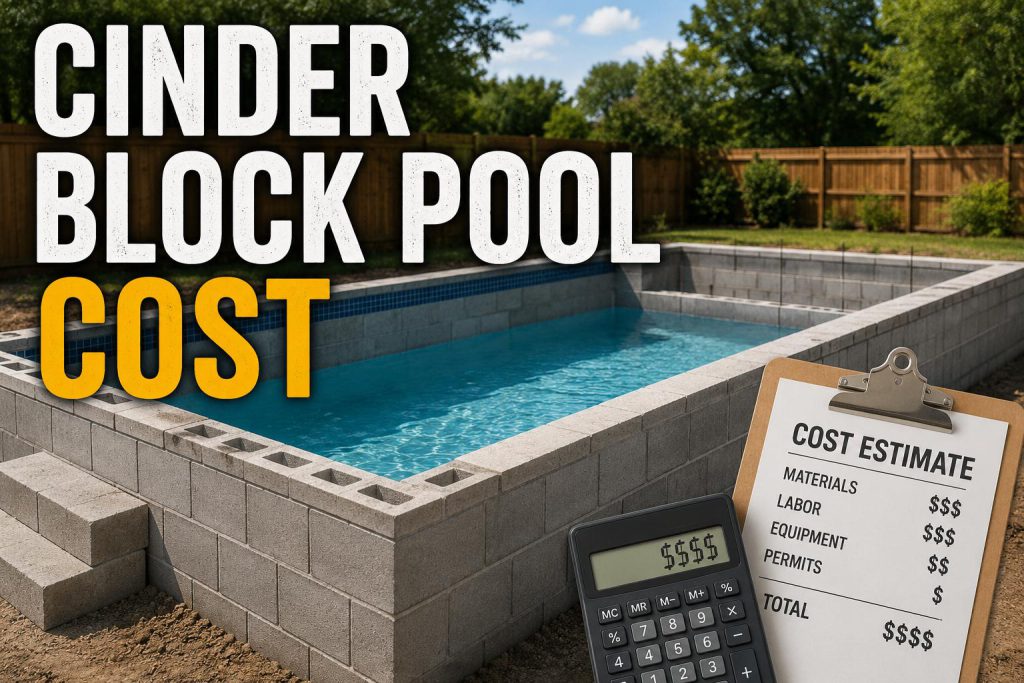
A cinder block pool — more accurately called a Concrete Masonry Unit or CMU pool — is an inground pool whose walls are constructed using standard concrete blocks (typically 8×8×16 inches) rather than being formed with poured concrete or sprayed gunite. The blocks are mortared together, reinforced with vertical steel rebar inserted through the hollow cores, and grouted solid to create a continuous structural wall. The interior is then waterproofed and finished with plaster, shotcrete, or a polymer coating.
The term “cinder block” is technically dated — true cinder blocks made from coal ash byproducts are rarely manufactured today. What’s sold as “cinder block” at building supply stores is almost always standard concrete masonry, made from Portland cement, aggregate, and water. The distinction matters only for pedantry; in common usage, cinder block pool refers to any CMU-constructed pool.
How CMU Pool Construction Works
CMU pool construction follows a logical sequence that experienced DIY builders can execute with proper planning.
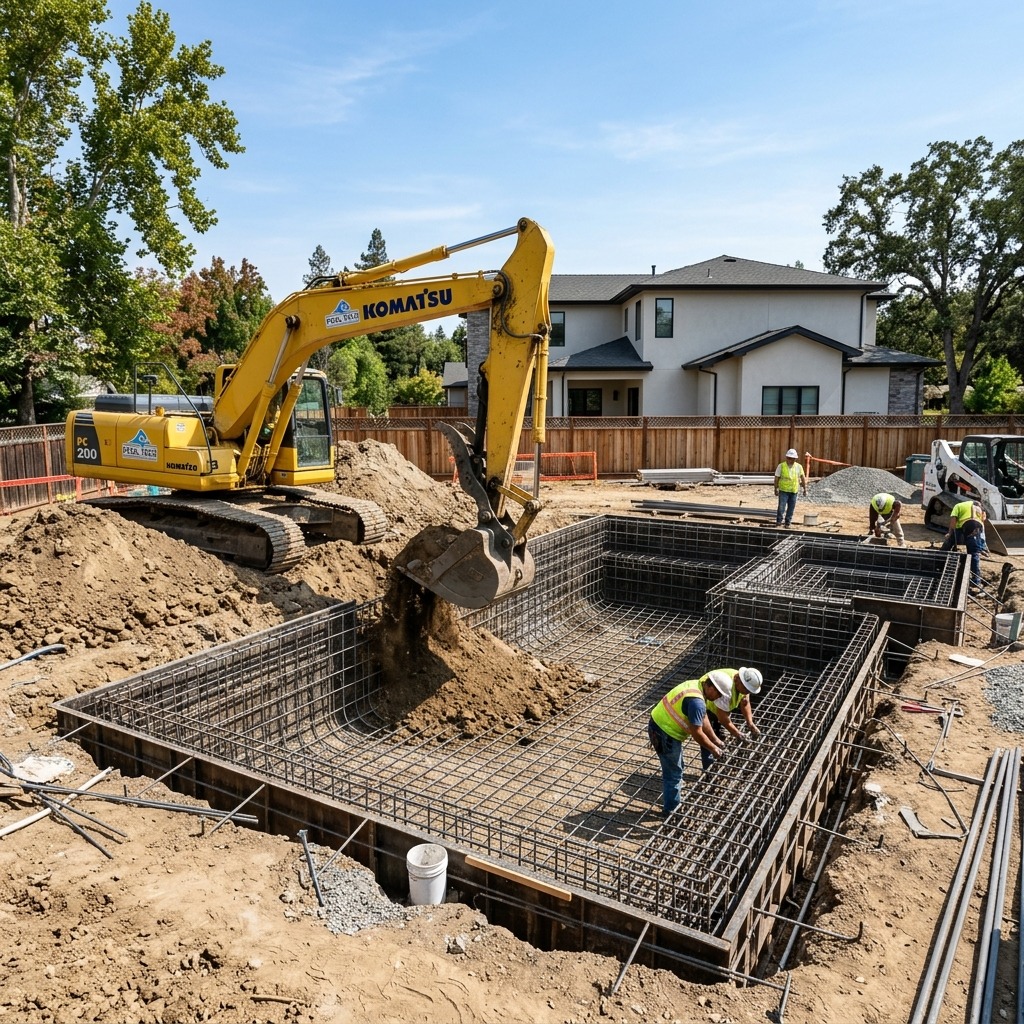
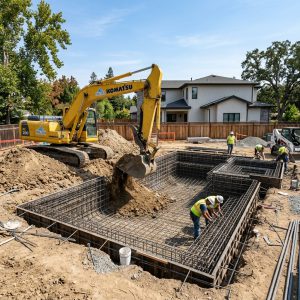
Foundation preparation: The pool cavity is excavated to finished dimensions plus allowance for the block wall thickness (typically 8–12 inches). The bottom of the excavation is leveled and a concrete footer is poured around the perimeter. This footer supports the block walls and must be properly sized — typically 12–16 inches wide and 8–12 inches deep — to distribute wall loads without settling.
Block wall construction: CMU blocks are laid in courses (horizontal layers) using standard masonry techniques. Vertical rebar is set in the footer and extends through the hollow cores of the blocks as each course is laid. Once the walls reach the desired height, all hollow block cores are filled with grout (a pourable concrete mix), encasing the rebar and creating a solid, reinforced wall. Horizontal rebar or ladder wire is typically added between courses for additional structural integrity.
Wall reinforcement and bracing: Before the pool is backfilled on the outside, the walls are typically braced to prevent inward collapse from soil pressure. In some designs, the excavation is sized to leave only minimal backfill, allowing the surrounding soil to provide passive support.
Waterproofing: This is the most critical and most frequently underestimated phase of CMU pool construction. CMU blocks are inherently porous — they will wick and transmit water without proper treatment. Multiple layers of waterproofing are typically required: a hydraulic cement skim coat to fill block surface voids, a crystalline waterproofing compound applied to the interior face, and then the finish coat (plaster, fiberglass, or polymer coating). Exterior waterproofing of the wall’s soil-side face is also recommended in most climates.
Interior finish and equipment: Once waterproofing cures, the interior finish (typically marcite plaster or a polymer-modified coating) is applied. Plumbing and electrical for filtration, returns, and skimmers are set during construction — ideally before wall construction progresses past the point where penetrations become difficult.
CMU vs. Gunite vs. Vinyl — Structural Comparison
| Characteristic | CMU Block | Gunite/Concrete | Vinyl Liner |
| Construction method | Block masonry | Pneumatic spray | Prefab or formed walls |
| Shape flexibility | Rectangular/geometric | Unlimited | Limited (kit sizes) |
| Shell strength (tensile) | Moderate | High | Low (liner is decorative) |
| Waterproofing source | Applied coatings | Dense concrete + plaster | Vinyl liner |
| DIY feasibility | High (skilled labor) | Very low (specialized equipment) | Moderate (kit systems) |
| Interior replastering | Required periodically | Required periodically | Liner replacement ($4k-$10k) |
| Contractor specialization | General masonry | Specialty pool contractor | Pool contractor |
| Average lifespan (shell) | 25–50 years | 40–70 years | 15–25 years (liner 8–12 yrs) |
| Typical 2026 cost | $20,000–$50,000 | $65,000–$175,000 | $35,000–$70,000 |
Who Builds Cinder Block Pools Today?
CMU pool construction is not common in suburban markets where gunite contractors are plentiful and residential pool building is a mature industry. It remains most common in three contexts:
Rural and agricultural properties: Where heavy gunite equipment is difficult to access, where skilled gunite contractors don’t operate, or where property owners have existing relationships with local masonry contractors who can build a functional CMU pool at a fraction of the gunite price.
Owner-builder projects: Homeowners with masonry experience (or the willingness to learn) who want to build their own pool. CMU construction is among the most DIY-accessible inground pool methods because it requires common skills and widely available materials rather than specialized equipment like a gunite pump rig.
Budget-constrained markets: In some regions, the cost gap between CMU and fiberglass is large enough to make CMU competitive even for standard residential builds, particularly when the homeowner can contribute significant labor.
Cinder Block Pool Cost Breakdown
The table below presents 2026 cost ranges for a standard rectangular CMU pool (approximately 12×24 feet, 4.5-foot average depth) broken down by construction phase. All figures assume contractor-performed work unless noted.
| Phase | Low Estimate | High Estimate | DIY Savings Potential |
| Design & layout | $500 | $2,000 | High — owner can draw simple plans |
| Permits & inspections | $800 | $4,000 | None — required regardless |
| Excavation | $2,000 | $6,000 | Moderate — rented equipment |
| Foundation footings (poured concrete) | $1,500 | $4,000 | Moderate |
| CMU blocks & mortar materials | $3,000 | $8,000 | Full material cost remains |
| Steel rebar & grout fill | $1,500 | $4,000 | Low — grout still needed |
| Waterproofing system | $2,000 | $6,000 | Moderate |
| Interior finish (plaster/polymer) | $3,000 | $8,000 | High if homeowner applies |
| Coping & tile | $1,500 | $5,000 | Moderate |
| Plumbing & filtration equipment | $3,000 | $8,000 | Low — licensed plumber needed |
| Electrical | $1,500 | $4,000 | None — licensed electrician |
| Decking (basic concrete) | $2,000 | $6,000 | High |
| Total Project Range | $22,300 | $65,000 | Contractor mid-range: ~$35,000 |
Block & Mortar Materials: $3,000–$8,000
Standard 8×8×16 CMU blocks cost $1.50–$3.00 each in 2026, depending on region. A 12×24-foot pool with 4.5-foot walls requires approximately 800–1,200 blocks for the walls alone. Add mortar ($30–$50 per bag, 50+ bags needed), type S or N mortar mix, and your block-and-mortar material budget runs $3,000–$8,000 depending on pool size, local material costs, and your block specification.
Higher-density CMU blocks (medium-weight or heavy-weight) are recommended for pool construction over standard lightweight blocks. They absorb less water, have higher compressive strength, and provide a better base for waterproofing coatings. The premium for heavier blocks is typically $0.30–$0.60 per block — worth every cent for a pool application.
Foundation & Footings: $2,000–$6,000
The continuous concrete footer that supports the CMU walls is a non-negotiable structural requirement. It must be poured on undisturbed or properly compacted soil, sized per your local engineering requirements, and set at the correct elevation to ensure the finished walls reach the desired deck height.
Footer cost varies based on pool perimeter, footer dimensions, and local concrete pricing. A 12×24-foot pool has approximately 72 linear feet of perimeter. At $25–$60 per linear foot for footer pour (including forming, concrete, and labor), budget $1,800–$4,320 for the footer alone. Add $200–$700 for a concrete pool floor (typically a 4-inch reinforced slab) and your foundation total runs $2,000–$6,000.
For homeowners wondering whether a building permit is required — yes, universally. Inground pools of any construction type require permits in all U.S. jurisdictions. The pool permit costs by state provides state-by-state cost data and what the permitting process typically includes for inground pool projects.
Steel Reinforcement & Waterproofing
Steel reinforcement is the structural backbone of a CMU pool. Vertical #4 (1/2-inch) or #5 (5/8-inch) rebar is set at 16- or 24-inch spacing through the block cores, which are then grouted solid. Horizontal rebar or joint reinforcement is added between courses. Without adequate steel, CMU pool walls are vulnerable to cracking under soil pressure — a risk that proper rebar installation eliminates.
Waterproofing deserves a separate section because it is the single most critical quality variable in CMU pool construction. The multi-layer system typically includes:
- Hydraulic cement skim coat: Fills block surface voids and creates a smooth base for waterproofing layers ($0.50–$1.50/sq ft material)
- Crystalline waterproofing compound (e.g., Xypex, Kryton): Penetrates the concrete matrix and forms crystals that block water migration ($2.00–$4.00/sq ft installed)
- Polymer coating or fiberglass reinforcement: Provides a flexible, impermeable outer barrier ($3.00–$6.00/sq ft installed)
Total waterproofing system cost for a standard pool interior: $2,000–$6,000. Attempting to save money by using single-layer waterproofing or skipping crystalline treatment is the most common cause of CMU pool failure. The pool maintenance cost calculator includes failure cost scenarios that illustrate exactly how expensive a leaking pool becomes over time.
Interior Finish Options
Once waterproofing is complete, the interior finish is applied. CMU pool owners typically choose one of three options:
Marcite plaster: The same material used in gunite pools. Cost: $3,000–$6,000 for a standard pool size. Requires replastering every 8–12 years. Most authentic-looking result.
Polymer-modified plaster or elastomeric coating: A flexible, water-based coating system designed for masonry substrates. Cost: $2,000–$5,000. Slightly less durable than marcite but better at accommodating minor structural movement without cracking.
Fiberglass liner applied in place: A fiberglass and resin system applied directly over the waterproofed CMU walls. Cost: $4,000–$9,000. Extremely durable; the fiberglass layer acts as both waterproofing and finish, lasting 15–25 years without replastering.
Total Project Range: $20,000–$50,000
A realistic contractor-built CMU pool project ranges from $22,000 (basic rectangular, minimal features, budget finishes) to $65,000 (larger pool, premium finishes, decorative coping, quality filtration). The sweet spot for most contract builds is $30,000–$45,000 — roughly half the cost of a comparable gunite installation.
CMU Pool Advantages
Understanding when CMU pools make sense requires a clear view of their genuine strengths — not just their cost, but the practical advantages they offer in specific situations.
Cost Advantage in Rural & DIY Builds
The cost advantage of CMU over gunite is most pronounced in markets where gunite contractor access is limited and mobilization costs are high. A rural property two hours from a major metropolitan area may face $15,000–$25,000 in gunite contractor mobilization and travel surcharges on top of normal pricing. Local masonry contractors, however, typically operate throughout rural markets and can build a competent CMU pool without travel surcharges.
For motivated DIY builders, the cost advantage is even more significant. The materials for a basic CMU pool (blocks, mortar, rebar, grout, waterproofing, plaster) cost $10,000–$18,000 for a small to medium pool. A skilled homeowner who contributes the masonry and finishing labor can build a functional inground pool for $15,000–$25,000 total — including permits, equipment, and professional plumbing/electrical. The DIY pool cost calculator provides a realistic breakdown of which phases are genuinely DIY-appropriate and which require licensed professionals regardless of construction method.
Custom Shapes Not Available in Pre-Made Options
CMU construction offers more geometric flexibility than vinyl liner kits and fiberglass shells, which come in fixed catalog sizes and shapes. While CMU is most economical in rectangular configurations, competent masonry contractors can build curved or L-shaped CMU pools by using cut blocks and careful layout. This gives homeowners who need a specific footprint — to fit an irregular lot, to work around a septic system, or to match an existing structure — an option that isn’t available in prefabricated form.
Repairability & Longevity
Unlike fiberglass pools (where shell damage requires professional fiberglass repair) or vinyl pools (where liner tears require replacement), CMU pools are highly repairable at the block level. A damaged section of wall can be tuckpointed, patched, or even rebuilt in sections using standard masonry skills and materials. This repairability gives CMU pools a practical durability advantage in situations where the pool may experience settling or impact damage.
Cinder Block Pool Disadvantages & Risks
An honest guide to CMU pools must be equally thorough about their limitations. These are real risks that should inform your decision, not just footnotes.
Water Seepage & Waterproofing Failures
CMU blocks are inherently porous. Without an impeccable, multi-layer waterproofing system properly applied, a CMU pool will leak. The consequences of waterproofing failure include: water loss requiring constant refilling, soil erosion around the pool structure, potential undermining of the block wall footings, and interior finish deterioration.
Waterproofing quality is the single largest variable in CMU pool long-term performance. The difference between a $2,000 waterproofing system and a $6,000 one is the difference between a pool that lasts 30 years and one that fails in 5. This is not a place to economize.
Structural Cracking Risk
Compared to a monolithic gunite shell — which is poured as a single structural unit — a CMU pool wall is an assembly of individual units joined by mortar joints. These joints are the weakest points. Differential settlement (one section of the pool foundation settling more than another due to soil variability) can open mortar joints and create pathways for water infiltration. Expansive soils, frost heave in cold climates, and poorly compacted fill are the primary causes of CMU pool structural cracking.
Proper site investigation and foundation design significantly reduce this risk. A soil bearing test before construction ($300–$800) and appropriate footer sizing can eliminate the most common causes of structural failure. The gunite pool cost estimator covers how gunite handles these same soil risks differently — useful context when evaluating which method is appropriate for your specific site conditions.
Limited Resale Value Impact
Real estate appraisers in most markets do not view CMU pools as equivalent to gunite or fiberglass installations. If a comparable home with a gunite pool appraised at $30,000 premium for the pool, a CMU pool on the same property might appraise at $10,000–$18,000 premium — or potentially have a neutral or negative impact if the pool shows signs of deferred maintenance or waterproofing issues.
This matters most if you plan to sell within 10 years of pool installation. If you’re building for long-term personal enjoyment on a property you intend to keep, the resale value gap is a less significant factor. But it’s important information to have before making the investment.
DIY Cinder Block Pool — Is It Realistic?
The honest answer: yes, for a subset of homeowners. Building your own CMU pool is a serious, multi-month commitment that requires masonry skills, physical stamina, access to construction equipment, a willingness to learn waterproofing and finishing techniques, and the ability to work alongside licensed plumbers and electricians where required by code.
Realistic DIY CMU pool projects typically involve:
- Owner handling: Excavation (rented equipment or hiring a machine operator), block laying, grouting, exterior backfill, waterproofing, and interior finishing
- Licensed professionals for: Electrical (bonding and equipment wiring — required by code in all U.S. jurisdictions), plumbing connections to filtration equipment (often required by code), and final inspection sign-off
A realistic 12×24-foot DIY CMU pool project timeline is 3–6 months of weekend work, depending on available labor help and weather. The physical demands of laying 1,000+ blocks, mixing and placing grout, and applying waterproofing coatings are substantial — this is genuinely hard work, not a casual weekend project.
The DIY pool cost calculator breaks down which cost categories DIY labor can realistically offset and which cannot be avoided regardless of how much work you contribute — an essential planning tool before committing to self-build.
For an honest comparison of what you’d get for the same budget with a professional contractor using conventional methods, the pool cost calculator vs estimator complete guide helps you understand the trade-offs between DIY CMU construction and professionally built alternatives in your price range.
The most common mistake in DIY CMU pool projects is underestimating the waterproofing phase. Homeowners who are meticulous block layers sometimes treat waterproofing as a straightforward final step and under-invest in both materials and technique. Given that waterproofing failure is the leading cause of CMU pool problems, any DIY builder should research and plan this phase as thoroughly as the structural construction itself.
How Long Does a Cinder Block Pool Last?
A well-built, properly waterproofed CMU pool has a realistic service life of 25–50 years for the structural shell. The interior finish — plaster or polymer coating — requires periodic renewal every 8–15 years, similar to gunite pool maintenance cycles.
The key variables affecting CMU pool lifespan are:
Waterproofing quality: As discussed throughout this guide, this is the dominant factor. A properly waterproofed CMU pool can outlast many gunite installations; an inadequately waterproofed one may fail within a decade.
Soil conditions: Stable, well-draining soil supports long pool life. Expansive clay, high groundwater, or fill material increase the risk of structural movement and joint cracking.
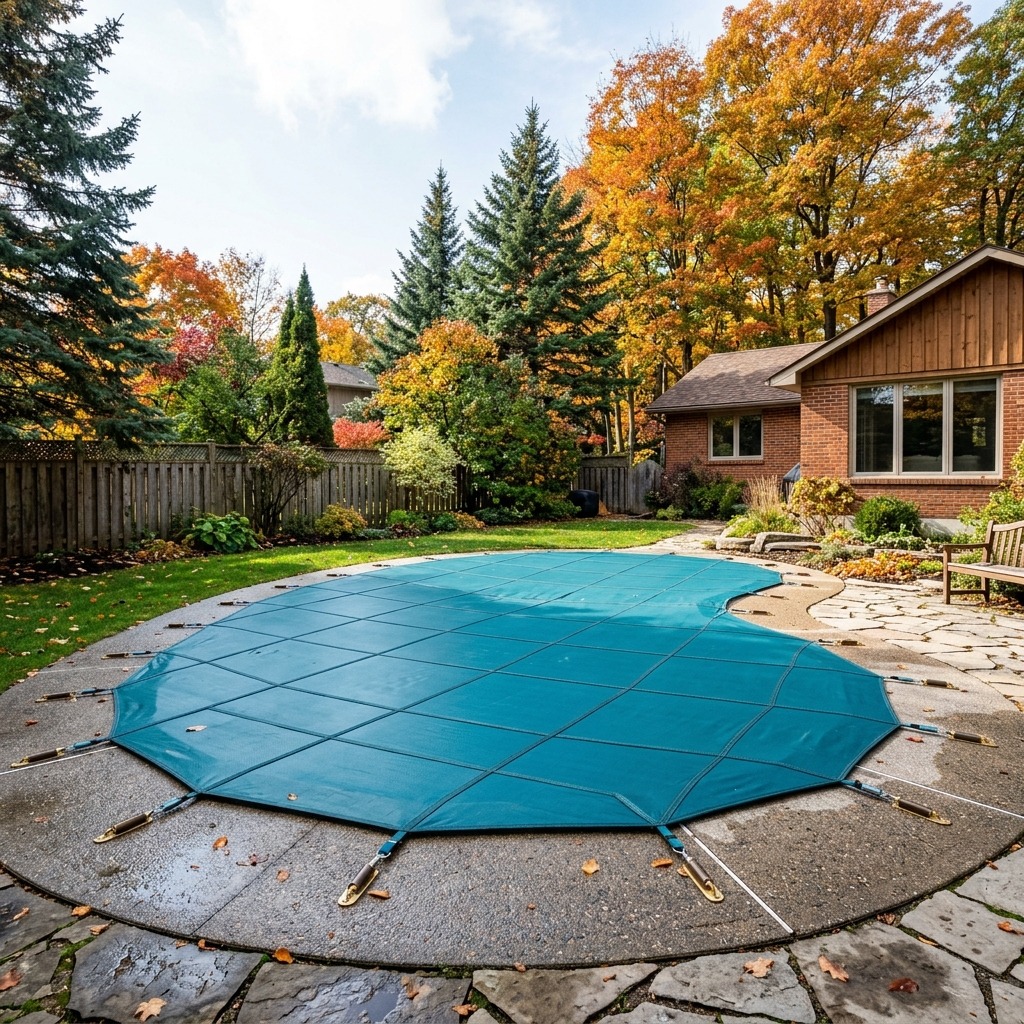
Climate: Freeze-thaw cycles affect CMU pools differently than they affect gunite. The mortar joints between blocks are more susceptible to freeze-thaw stress than a monolithic concrete shell. CMU pools in northern climates should be properly winterized and ideally designed with exterior drainage to prevent groundwater from freezing against the block wall.
Maintenance consistency: Like all pool types, CMU pools reward consistent maintenance with extended service life. Deferred maintenance — particularly ignoring early signs of waterproofing breach — accelerates deterioration significantly.
Getting an Accurate Cinder Block Pool Estimate
Cinder blocks offer a cheap and DIY-friendly frame, but your final price depends on the finish and plumbing you choose. You can map out these expenses by using our cinder block pool cost calculator to compare liner and decking options. Just plug in your dimensions to get a realistic budget for your yard.
Getting an accurate CMU pool estimate is more complex than estimating conventional pool types because fewer contractors specialize in this construction method and pricing varies significantly by region.
Find the right contractor type. In most markets, CMU pools are built by masonry contractors with pool experience, not by conventional pool contractors. Contact masonry contractors directly and ask about pool experience. An experienced masonry contractor who has built 5+ pools will produce a better result than a pool contractor who has never worked with CMU.
Get material quotes independently. Because block, mortar, rebar, and waterproofing materials are commodity products available at any building supply store, you can price materials independently and verify that contractor quotes are using quality materials at reasonable markups.
Inspect completed projects. Ask any CMU pool contractor to show you a completed project — ideally one that’s 5–10 years old, so you can evaluate how the waterproofing has held up over time rather than just admiring fresh construction.
Don’t compare CMU quotes to gunite quotes by total number alone. A $35,000 CMU pool and an $85,000 gunite pool are genuinely different products. The gunite pool cost estimator provides a full understanding of what you’re getting in a gunite build at various price points — knowledge that makes the comparison meaningful rather than purely numerical.
Budget for proper waterproofing — don’t cut this line item. If you receive quotes that show minimal waterproofing cost (under $1,500), ask specifically what products and application layers are specified. A CMU pool waterproofed with a single coat of standard pool paint is not an adequate build; make sure your quote specifies a multi-layer system.
Conclusion
A cinder block pool will never be the right choice for everyone — and this guide hasn’t tried to make it seem so. If you’re building a premium residential pool in a suburb with easy contractor access, a standard budget, and normal lot conditions, gunite or fiberglass will serve you better in almost every measurable way.
But if you’re a rural property owner who faces gunite contractor access challenges, a serious DIY builder who wants to contribute meaningful labor to a significant project, or a homeowner working with a tighter budget who understands the maintenance commitments involved — a CMU pool is a legitimate, buildable, and genuinely cost-effective option that deserves a place in your decision process.
The cinder block pool cost range of $20,000–$50,000 for a professional build represents real value for the right project in the right hands. The key to getting that value is investing properly in waterproofing, working with experienced masonry contractors, and approaching the project with clear eyes about both its advantages and its limitations.
Use this guide as your foundation for an informed decision. Compare CMU against conventional options using accurate data. Get quotes from masonry contractors with pool experience. And when you’re ready to build a realistic budget for any pool type, use the estimating tools at poolcostestimator.com to enter your project specifics and get a 2026 market-calibrated range you can trust.
Frequently Asked Questions
How much does a cinder block pool cost in 2026?
According to 2026 contractor and material pricing data, a professionally built CMU pool costs $20,000–$50,000 for a standard rectangular design. The wide range reflects pool size, finish quality, local labor rates, and site conditions. A DIY-built pool with purchased materials but owner-supplied labor can fall in the $12,000–$22,000 range. Custom shapes or premium finishes push costs toward $55,000–$65,000.
Are cinder block pools as good as gunite pools?
It depends on what “as good” means in your situation. For structural longevity and design flexibility, gunite is superior. For DIY feasibility and low cost on simple rectangular designs in accessible locations, CMU offers genuine advantages. A properly built and maintained CMU pool can provide 25–40 years of service, which is a reasonable return on the lower investment. The gunite pool cost estimator can help you understand what the cost premium for gunite buys you before making a final decision.
Can a cinder block pool be built DIY?
Yes — more realistically than any other inground pool type. The required skills (masonry, basic concrete work) and materials (CMU blocks, mortar, rebar) are more accessible than gunite application equipment or fiberglass fabrication. The realistic DIY cost savings are $8,000–$20,000 in labor on a standard project, but the time commitment is 3–6 months of serious work. Always hire licensed professionals for plumbing and electrical connections.
How do you waterproof a cinder block pool?
Proper CMU pool waterproofing requires multiple layers: a hydraulic cement skim coat to fill surface voids, a crystalline waterproofing compound that penetrates the block matrix, and a final polymer or fiberglass coating as the interior finish surface. Exterior waterproofing of the soil-side wall face is also recommended. Single-layer waterproofing systems are inadequate for below-grade pool applications.
How long do cinder block pools last?
A well-built, properly waterproofed CMU pool has a structural lifespan of 25–50 years. The interior finish (plaster) requires renewal every 8–15 years at a cost of $3,000–$8,000 per replastering. In favorable soil conditions and climates, CMU pools routinely outlast their initial interior finish by several replastering cycles.
Can I convert a cinder block pool to a different interior finish later?
Yes — this is one of CMU’s genuine advantages. The block shell can accept virtually any interior finish system that can be applied to concrete masonry: marcite plaster, quartz aggregate, fiberglass spray-up, polymer coatings, or even glass tile (with appropriate substrate preparation). If your initial plaster finish ages or fails, replastering or upgrading to a more durable finish system is straightforward. The pool maintenance cost calculator can help you project the full lifecycle cost of different finish choices over a 20+ year ownership period.