The idea of building your own pool — or at least managing the build yourself to slash contractor markups — is one of the most persistent fantasies in the home improvement world. Videos of homeowners excavating their own backyards and installing vinyl liner kits get millions of views. DIY pool Facebook groups count hundreds of thousands of members. And yes, there are real, documented cases of homeowners completing functional inground pools for a fraction of professional quotes.
But the DIY pool cost calculator reality is considerably more nuanced than those success stories suggest. For every homeowner who successfully project-manages their own build and saves $20,000, there are others who discover midway through that they’ve violated their permit, botched their electrical bonding, or created a structure their homeowner’s insurance won’t cover. The gap between what you can legally and practically do yourself and what you must hire licensed professionals for is wide — and costly to misjudge.
This guide gives you the complete, unvarnished picture: a real DIY pool cost calculator framework, an honest breakdown of where you can actually save money versus where cutting corners creates risks that dwarf the savings, and a clear-eyed self-assessment to determine whether DIY is genuinely right for your situation heading into 2026.
Key Takeaways
– A professionally built inground pool costs $50,000–$100,000+; a skilled owner-managed DIY build can reduce this to $25,000–$55,000 — but only with the right conditions.
– Homeowners can legally self-perform tasks like decking, landscaping, backfill assistance, and some plumbing rough-in — but electrical, gunite, and structural work almost always requires licensed contractors.
– Owner-builder permits are available in many states but carry significant liability implications — you become the contractor of record for all inspections and code compliance.
– The biggest DIY risk is not the physical build — it is mistakes that cost more to fix than a professional would have charged (failed electrical bonding, improper grading, structural failures).
– Vinyl liner kit pools and fiberglass shell purchases are the two most DIY-friendly pool types for inground installations in 2026.
– A realistic DIY build timeline for an inground pool is 6–18 months when self-managing — three to five times longer than a professional build.
What Can You Actually DIY on a Pool Build?
This is the most important question in any DIY pool conversation, and the honest answer is more limited than most YouTube videos suggest. Swimming pools are regulated construction projects in every U.S. state, subject to building codes, electrical codes, and often health department regulations. The scope of work a homeowner can legally perform varies by state and municipality.
Tasks Homeowners Can Legally Do
Even in states with strict contractor licensing requirements, there are meaningful portions of a pool project that homeowners can self-perform or assist with legally:
Site preparation and rough grading: Moving dirt, clearing vegetation, and general site prep are typically unregulated activities a homeowner can do independently or with rented equipment.
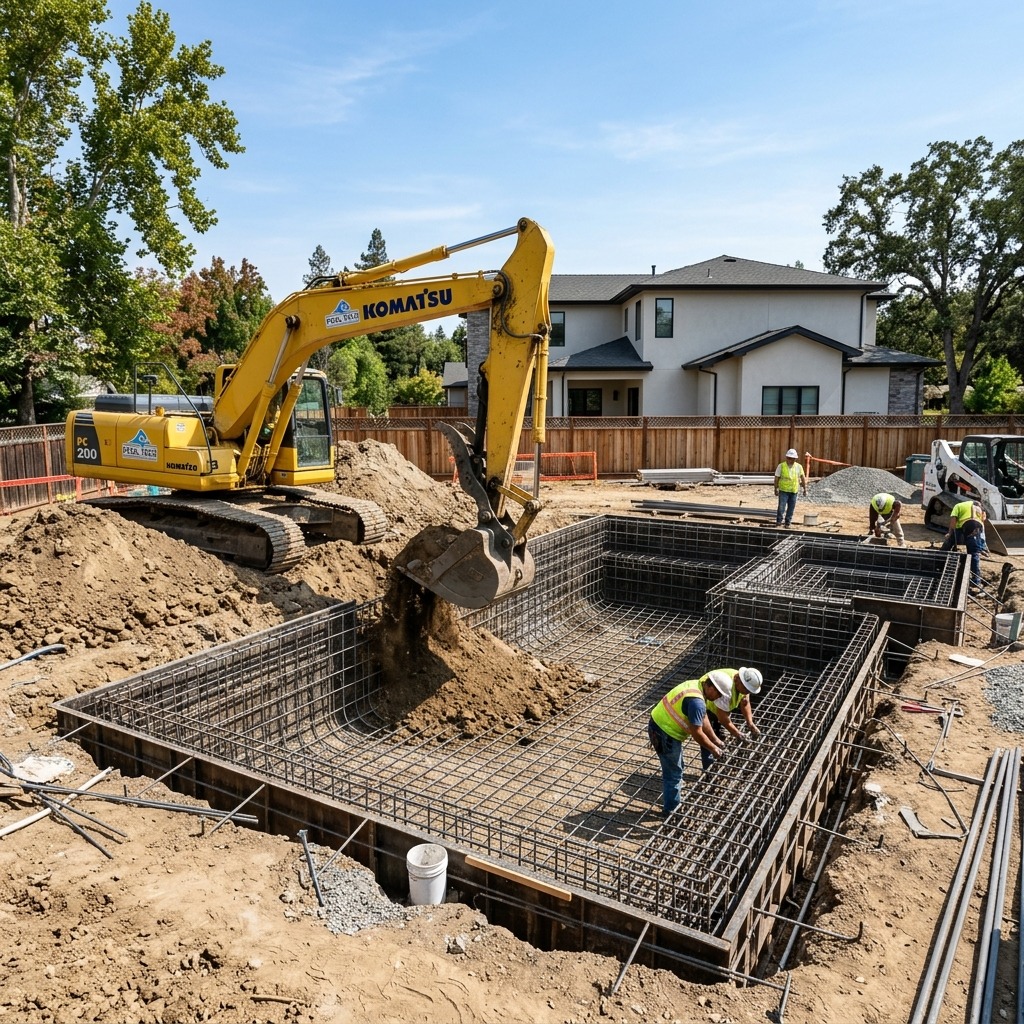
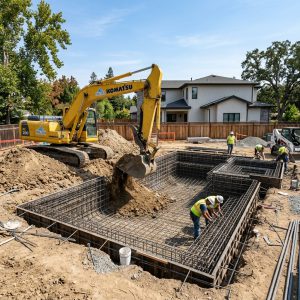
Excavation assistance: In many jurisdictions, homeowners can operate excavation equipment or assist a hired excavator during the digging phase. Excavation itself is rarely a licensed-contractor-only activity.
Backfill operations: After the pool shell is set and plumbing rough-in is complete, the backfill and compaction around the pool walls is work many homeowners can do themselves or with basic equipment rental.
Decking and coping installation: Pool decking (concrete, pavers, stone, or composite wood) is a significant cost item that homeowners with construction skills can often self-perform. Depending on your jurisdiction, concrete flatwork may require a licensed contractor for permit compliance, but many homeowners successfully manage their own paver or stone decking installation.
Landscaping: Virtually all landscaping around the pool — planting, mulching, fencing (decorative, not safety-barrier), lighting (low-voltage), and hardscaping details — can be self-performed.
Interior finishing preparation: For vinyl liner pools, homeowners often handle the coping track installation and base prep. For fiberglass, the interior finish is factory-applied and requires no homeowner work.
Tasks Requiring Licensed Contractors
These are the non-negotiable professional domains in virtually every U.S. jurisdiction:
Electrical work: All pool electrical — from the main bonding and grounding system to equipment panel connections, lights, and outlets within the pool area — must be performed by a licensed electrician in every state. The National Electrical Code (NEC) has strict pool area requirements, and uninspected electrical work around water is genuinely life-threatening. This is the single area where DIY shortcuts carry the highest risk of fatal consequences.
Gunite or shotcrete application: If you’re building a concrete (gunite or shotcrete) pool, the actual concrete application requires specialized equipment and trained crews. This is not a self-perform option for any homeowner.
Plumbing requiring permits: Main drain, return line, and equipment pad plumbing typically requires a licensed plumber in most states. Some states allow homeowner plumbing under an owner-builder permit.
Gas connections: If your pool equipment includes a gas heater, the gas line connection and equipment connection require a licensed plumber or gas fitter in all jurisdictions.
Owner-Builder Permits — State-by-State Reality
Many states offer owner-builder permits that allow a homeowner to act as their own general contractor, pulling permits and taking on the legal responsibility for code compliance. Before using one, understanding the full implications is critical. Consult the pool permit costs by state resource to understand both fee structures and permit requirements across different states.
States with relatively homeowner-friendly owner-builder laws include Florida, Texas, Arizona, and California (with some restrictions). States with more restrictive contractor-licensing laws — including Massachusetts, Louisiana, and several others — limit the scope of work homeowners can legally self-perform even under an owner-builder permit.
The critical caveat: when you pull an owner-builder permit, you become the contractor of record. You are legally responsible for all inspections passing, for code compliance throughout the project, and — in many states — for any construction defects for 10 years. If you sell the home within a certain period, the owner-builder status may need to be disclosed to buyers and can complicate the transaction.
DIY Pool Cost Breakdown vs. Professional Build
Here is the core comparison most homeowners are searching for when they look for a DIY pool cost calculator. These figures reflect 2026 national average data for a standard 12′ × 24′ inground vinyl liner pool:
| Phase | Professional Build Cost | DIY-Managed Cost | Self-Perform Savings |
| Design & Permits | $3,000–$8,000 | $1,000–$3,000 | ~$3,000–$5,000 |
| Excavation | $5,000–$12,000 | $3,000–$7,000 | ~$2,000–$5,000 |
| Pool Shell/Walls | $8,000–$18,000 | $8,000–$15,000 | ~$2,000–$3,000 |
| Plumbing (rough-in) | $4,000–$9,000 | $2,500–$6,000 | ~$1,500–$3,000 |
| Electrical | $3,000–$7,000 | $3,000–$7,000 | $0 (must use licensed electrician) |
| Equipment (pump, filter, heater) | $4,000–$10,000 | $3,500–$8,000 | ~$500–$2,000 (direct purchase) |
| Decking & Coping | $8,000–$25,000 | $2,000–$10,000 | ~$6,000–$15,000 |
| Liner Installation | $1,500–$4,000 | $800–$2,000 | ~$700–$2,000 |
| Landscaping & Fencing | $5,000–$15,000 | $1,500–$5,000 | ~$3,500–$10,000 |
| Total | $41,500–$108,000 | $25,300–$63,000 | ~$15,000–$45,000 |
For a broader understanding of how professional quotes are structured, the pool cost calculator vs estimator complete guide explains exactly what each line item includes and how contractors mark up materials and subcontractor labor.
Professional Inground Pool: $50,000–$100,000
A fully contractor-managed inground pool in 2026 — from design through final inspection and landscaping — typically lands between $50,000 and $100,000 for a standard vinyl liner or fiberglass pool in the 400–500 square foot range. Higher-end finishes, larger dimensions, water features, or complex site conditions push projects well above $100,000.
The professional build includes general contractor overhead (typically 15–25% of total project cost), warranty coverage, licensed subcontractors for all regulated trades, and the time-efficiency of an experienced crew that has completed the same construction sequence dozens or hundreds of times.
DIY-Managed Inground Pool: $25,000–$55,000
A competent owner-manager who pulls their own permits, self-performs eligible tasks, sources materials independently, and hires individual licensed subcontractors for regulated trades (electrical, some plumbing) can realistically complete an inground vinyl liner pool for $25,000–$55,000. The wide range reflects the scope of self-performed work, local material costs, and the extent to which the owner can perform skilled tasks like decking and landscaping themselves.
Labor Savings Breakdown by Phase
The biggest savings opportunity is always in the labor-intensive, non-licensed trades: decking, landscaping, backfill, and project management. A professional pool company’s project management overhead — coordinating subcontractors, scheduling inspections, managing material deliveries — is absorbed into the contractor’s markup and can represent $5,000–$15,000 of a mid-range build. An organized owner-builder who can manage these logistics themselves captures most of that cost directly.
Best DIY Pool Options — Kits That Work
For homeowners serious about DIY, there are pool product categories specifically designed with owner-installation in mind:
Vinyl Liner Kit Pools: $8,000–$20,000 for Materials
Vinyl liner pool kits — available from manufacturers like Pool Kit Market, Swim USA, and others — include pre-manufactured steel or polymer wall panels, all necessary hardware, the vinyl liner itself, and detailed installation instructions. The kit provides the “shell” of the pool; you supply the excavation, backfill, plumbing, electrical, and finishing.
Material costs for a 12′ × 24′ vinyl liner kit run $8,000–$14,000. Adding excavation, plumbing, electrical, and minimal decking brings a completed kit pool to $20,000–$35,000 in total — still substantially below professional alternatives. The above ground pool cost estimator offers useful context on above-ground alternatives if your budget makes even DIY inground installation challenging.
Fiberglass Shell-Only Purchase: $12,000–$25,000
Some fiberglass pool manufacturers and dealers will sell the pool shell alone — without installation — to owner-builders. The shell is delivered to your site by flatbed truck and set into the excavation with a crane. Once set, you handle backfilling, plumbing connections, electrical, and all finishing work.
The fiberglass shell itself costs $12,000–$25,000 depending on size and model. The DIY-installed total project cost for a fiberglass pool typically runs $25,000–$45,000 — versus $45,000–$80,000 for a professionally installed fiberglass build. The vinyl liner vs fiberglass pool true 10-year price comparison gives essential context on which shell type makes more sense for a DIY approach over the full ownership period.
Steel Wall Panel Pool Kits
A third option is steel wall panel pool kits — similar to vinyl liner kits but using heavier-gauge steel panels with improved structural rigidity. These are popular with DIY builders who want more confidence in the structural integrity of their installation, particularly in softer or more variable soil conditions. Panel pool kits run $9,000–$18,000 for materials in standard sizes and are available from most major pool supply distributors.
Hidden Costs of Going DIY
The cost comparisons above represent ideal-scenario DIY builds. In the real world, several hidden costs regularly push DIY projects beyond their initial budgets:
Equipment Rental for Excavation
Most DIY pool builders do not own the heavy equipment needed for excavation. Renting an excavator or mini-excavator for a pool dig typically costs $400–$800/day, plus delivery fees of $200–$500. A standard pool excavation takes 1–3 days depending on soil conditions and equipment size, putting equipment rental costs at $600–$2,900 — before you factor in your own time and the learning curve of operating unfamiliar heavy equipment.
Alternatively, hiring an excavation-only contractor (without pool expertise) to dig your hole runs $2,000–$5,000 in most markets, which is often more efficient than self-operating rental equipment for first-time excavators.
Mistakes That Cost More to Fix Than a Pro
This is the most significant financial risk in any DIY pool project, and it is the factor most often omitted from the optimistic YouTube tutorials. Common costly mistakes include:
Improper base preparation: If the pool floor is not properly leveled and compacted before setting the liner, you will have wrinkles, uneven wear, and potentially structural settling that requires liner removal and reinstallation — a $2,000–$5,000 repair.
Incorrect plumbing slope: Pool return lines and main drain runs that are not correctly sloped can trap air, prevent complete drainage, or create vacuum conditions that collapse flexible pipe sections. Excavating and re-running plumbing after backfill is extremely expensive — $3,000–$8,000.
Backfill before plumbing inspection: Covering plumbing before inspection requires excavation to expose lines — adding significant unplanned cost and time.
Structural failures in wall panels: Incorrectly assembled or improperly braced wall panels that shift during backfill can result in a deformed pool shell that is essentially unrepairable without complete demolition.
Insurance & Liability Issues
A DIY pool build creates insurance exposure that many homeowners do not anticipate. Homeowner’s insurance policies may not automatically cover injuries that occur during construction by the homeowner. An owner-builder project that suffers a structural failure, electrical issue, or injury during construction may face coverage disputes.
After the pool is complete, some homeowner’s insurance carriers require confirmation that licensed, permitted contractors performed all regulated work before they will include pool-related liability in your policy. A DIY project that skirted licensed contractor requirements can result in coverage gaps that only become apparent when you file a claim. The ongoing annual pool maintenance cost calculator projections also change if insurance requirements force post-completion remediation work.
How Long Does a DIY Pool Build Take?
This is one of the most significant practical differences between a professional build and a DIY-managed project, and it is almost always underestimated.
A professional pool company, with coordinated crews and an established subcontractor network, can complete a vinyl liner pool from excavation to water in 4–8 weeks. Complex projects might take 10–14 weeks, but the professional machine is optimized for speed.
A DIY-managed build — even a well-organized one — typically takes 6–18 months from permit application to swim-ready completion. The reasons are predictable:
Permit approval timelines: Owner-builder permits in many jurisdictions take 4–12 weeks to approve, during which no ground-breaking can occur.
Subcontractor scheduling: When you are not a regular-volume customer for electrical contractors and plumbers, you go to the back of their scheduling queue. Waits of 2–6 weeks between subcontractor visits are common for DIY projects.
Learning curve delays: Every phase of a pool build involves decisions and techniques that experienced crews execute in hours. First-time owner-builders take significantly longer to accomplish the same tasks.
Inspection turnaround: Building departments in many jurisdictions have inspection backlogs of 1–3 weeks. Each phase of construction requires a passed inspection before proceeding to the next phase.
The practical implication: if you start a DIY pool project in spring, you should not expect to swim in it until the following summer at the earliest. This extended timeline has real costs — carrying a half-finished construction project through a full weather cycle can expose materials to damage and complicate storage and site security.
DIY Pool Safety — What You Cannot Skip
There are two safety systems in every pool where errors have killed people, and where no amount of cost-saving ambition should lead you to cut corners.
Electrical Grounding & Bonding (Non-Negotiable)
Pool electrical bonding and grounding is a specific, NEC-mandated system that connects all metal components in and around the pool to a common equipotential plane. When correctly installed, this system ensures that no dangerous voltage differential can exist between any two points in or around the pool. When it is incorrectly installed or omitted, swimmers can experience electric shock drowning (ESD) — a phenomenon where stray current in pool water paralyzes a swimmer who cannot exit. ESD has killed swimmers in pools across the United States, and nearly every case involves an electrical system failure.
All bonding and grounding work must be performed by a licensed electrician and inspected by your local building authority before the pool is filled with water. This is a non-negotiable requirement with no legitimate DIY workaround.
Barrier & Fencing Laws
Every U.S. state has pool barrier requirements — laws specifying the type, height, and self-closing/latching requirements for fencing that must enclose a swimming pool. These laws exist because residential pool drownings are the leading cause of accidental death for children ages 1–4 in the United States.
The requirements vary by state and municipality, but the minimum standard in most jurisdictions is a 4-foot fence (48 inches) with a self-closing, self-latching gate that opens outward, with no footholds on the exterior. Many jurisdictions require 5-foot or 6-foot barriers. All safety barriers must be installed and inspected before the pool is filled. Building without proper barriers — or filling the pool before barriers are approved — can result in stop-work orders, fines, and personal liability in the event of a drowning.
Is DIY the Right Choice? Self-Assessment Checklist
Before committing to a DIY pool build, work through this honest assessment:
Construction skills: Do you have meaningful experience with construction projects — not just watching tutorials, but actually building, grading, working with concrete, and reading blueprints? If your last home improvement project was painting a room, a DIY pool build is a significant skills jump.
Physical capacity: Pool construction is physically demanding — digging, hauling, mixing, and installing in all weather conditions. Honestly assess whether you can physically manage 200–400 hours of construction labor over the build period.
Time availability: Do you have 10–20 hours per week to dedicate to the project for 6–18 months? A stalled DIY pool build sitting open in your backyard is a safety hazard, a neighborhood complaint, and a morale drain.
Financial cushion: Do you have 20–30% above your estimated budget for inevitable overruns? The typical DIY pool build runs over initial estimates by 15–35%.
Local permit access: Has your local building department confirmed that owner-builder permits are available for pools in your jurisdiction and that you understand all the inspection requirements?
Honest skill gap assessment: Are you willing to hire licensed contractors for electrical and other regulated trades without cutting corners, even when it feels expensive?
If you can answer yes to all six of these honestly, a DIY pool build may be genuinely appropriate for your situation. If you have reservations about two or more, a professionally managed build with homeowner contributions in the unregulated phases (decking, landscaping) is likely a better path to a successful outcome.
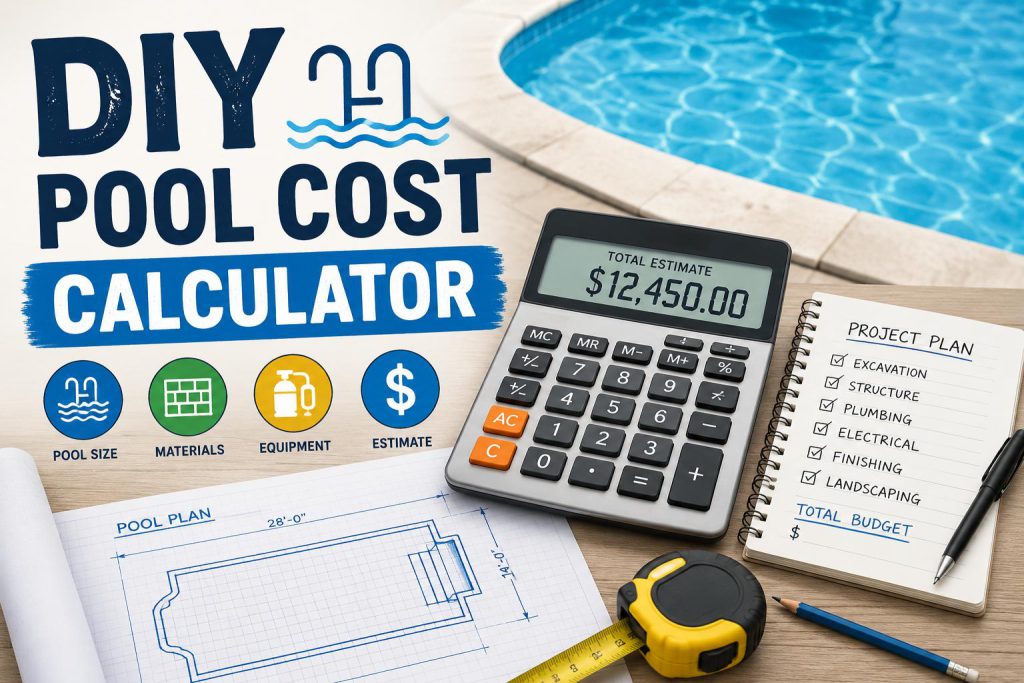
Doing the heavy lifting yourself saves thousands, as long as you track equipment rentals and material deliveries accurately. You can map out your exact material budget using our DIY pool cost calculator. By separating the labor from the parts, you can decide if the sweat equity makes sense for you.
Conclusion
A DIY pool build is not a shortcut — it is an alternative path to the same destination, with a different set of demands, risks, and rewards. For the right homeowner, with the right skills, time, and access to owner-builder permits, the savings are real and the satisfaction of swimming in a pool you built yourself is genuine. For homeowners who underestimate the complexity, the licensing requirements, or the safety stakes — particularly around electrical work — the DIY path can end up costing more than a professional build and creating risks that outlast the project.
The most financially sensible approach for most homeowners is a hybrid: use a professional contractor for the regulated, high-risk, specialized trades, and aggressively self-perform the unregulated phases where your skills are sufficient — decking, landscaping, backfill, finishing details. This hybrid approach can save $10,000–$20,000 on a mid-range pool build without the full liability exposure of a complete owner-builder project.
Ready to build your own budget? Start with our free cost estimator at poolcostestimator.com to calculate what your specific pool configuration would cost professionally built — then decide which phases you want to take on yourself. Knowledge is your most valuable construction tool.
Frequently Asked Questions — DIY Pool Costs
How much can I realistically save by building a pool myself?
Realistic savings for an owner-managed DIY inground pool project range from $15,000 to $45,000 compared to a fully contractor-managed build, depending on the scope of work you self-perform, your local labor market, and the type of pool. The most significant savings come from self-performing decking, landscaping, and backfill, and from eliminating the general contractor’s project management markup (typically 15–25% of total project cost). Zero savings should be expected on regulated trade work like electrical and licensed plumbing.
What is the cheapest type of pool to build yourself?
For DIY inground pools, vinyl liner kit pools offer the lowest material cost — $8,000–$20,000 for the pool kit itself — and the most established owner-installation tradition. Above-ground pools remain the least expensive DIY option overall, with quality above-ground pools installable for $3,000–$8,000 in materials with minimal equipment or skills requirements.
Can I dig my own pool with rented equipment?
In most jurisdictions, yes — excavation is not a licensed-contractor-only activity. However, pool excavation requires more precision than general digging: specific dimensions, slope angles, shelf levels for benches or steps, and careful management around existing utilities. Renting and operating an excavator without prior experience significantly increases the risk of dimensional errors that are expensive to correct after the fact.
What happens if I build a pool without permits?
Building a pool without permits (or without passing required inspections) creates significant legal and financial exposure. Unpermitted pools can result in: stop-work orders that freeze the project, mandatory demolition orders in extreme cases, substantial fines, and complications when selling the property (unpermitted pools must typically be disclosed and can kill real estate transactions). Most importantly, unpermitted pool electrical systems cannot be inspected for safety, creating genuine risk of electric shock drowning.
How do I find a good electrician for pool bonding and grounding?
Ask specifically for an electrician with residential pool bonding experience — not all electricians are familiar with NEC pool area requirements. Pool equipment companies and pool contractors often have established relationships with pool-experienced electricians and can provide referrals. Get at least two quotes and verify that each electrician has pulled pool electrical permits in your jurisdiction before — this confirms they understand the local inspection process.
Does homeowner’s insurance cover a DIY pool?
Coverage varies significantly by insurer and policy. Most homeowner’s insurance policies will cover a completed, permitted pool for liability and property damage. However, policies may not cover construction-phase injuries or accidents during the owner-builder build process. After completion, some insurers require documentation that licensed contractors performed regulated work (electrical, plumbing) before including pool liability coverage. Contact your insurer before starting a DIY pool project to understand your coverage position.