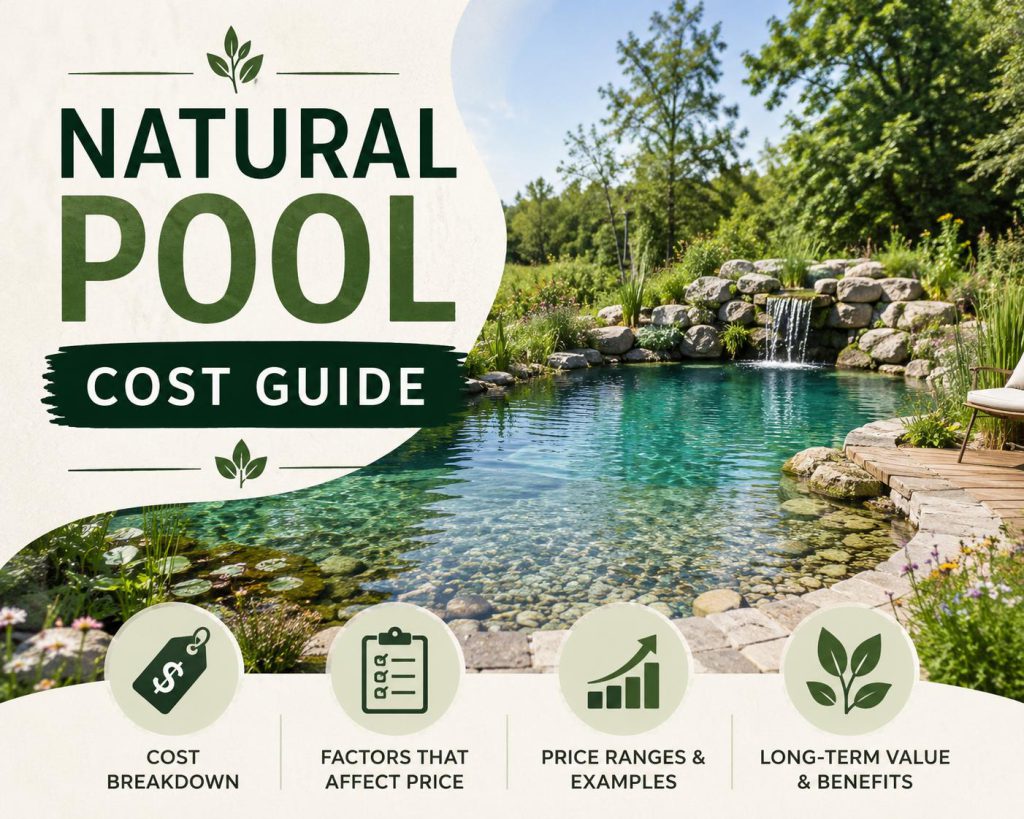
If you’ve ever swum in a lake and thought, why can’t my backyard pool feel like this? — you’re not alone. Natural pools are one of the fastest-growing segments in the residential pool market, blending the aesthetics of a garden pond with the function of a swim-ready pool, all without a drop of chlorine. But that serene, living ecosystem comes at a price, and understanding exactly what drives that price is the difference between a project that transforms your property and one that quietly breaks your budget.
Natural pool cost ranges are wide — typically $50,000 to $150,000 or more depending on size, design, and your region. That’s a premium over a comparably sized conventional pool, but the math changes significantly when you factor in a decade of chemical-free maintenance, elevated curb appeal, and an experience that no chlorinated pool can replicate. This guide breaks down every cost layer — from excavation to ecosystem planting — so you can walk into contractor conversations with real numbers and real expectations.
Whether you’re comparing a natural pool against a traditional inground build or simply exploring whether going chemical-free is financially realistic for your backyard, this guide covers everything you need to know heading into 2026.
Key Takeaways
– Natural pools typically cost $50,000–$150,000+ to build, compared to $35,000–$100,000 for a conventional inground pool.
– They use a biological regeneration zone — a planted filter area — instead of chlorine or saltwater systems.
– The higher upfront cost is partially offset by significantly lower annual maintenance costs (roughly $500–$1,500/year vs. $1,200–$3,000/year for chemical pools).
– Specialist contractors are scarce in the U.S., which adds premium labor costs vs. Europe where natural pools are far more common.
– Permits exist in a regulatory gray area in many states — some classify them as pools, others as ponds; confirm with your local authority before budgeting.
– Over a 10-year period, the total cost of ownership can approach parity with or even undercut a high-end conventional pool when maintenance savings are included.
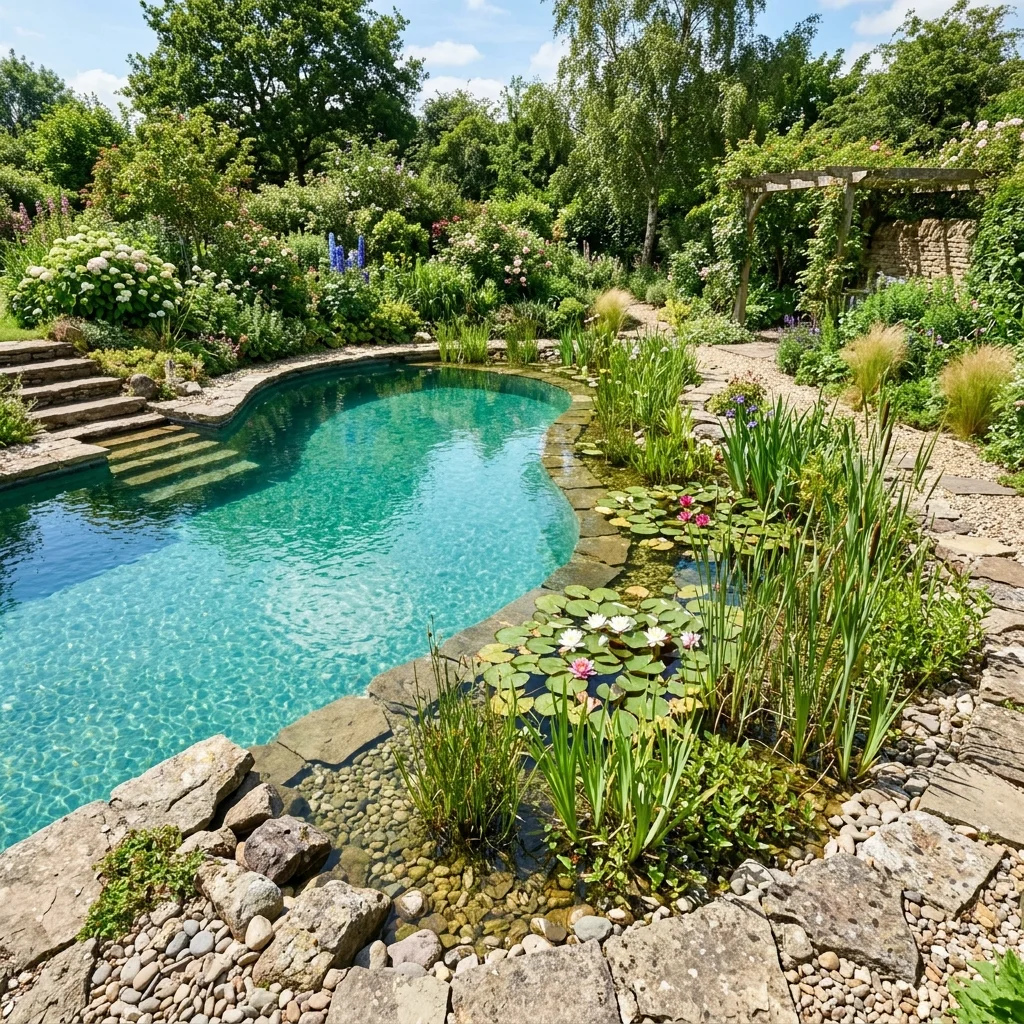
What Is a Natural Swimming Pool?
A natural swimming pool (NSP) — also called a natural swimming pond or bio pool — is a body of water designed for human swimming that is cleaned and maintained entirely through natural biological processes rather than synthetic chemicals. The concept originated in Austria and Germany in the 1980s and has become widespread across Europe over the past three decades. In the United States, it remains a niche but rapidly growing category.
Unlike conventional pools where water clarity is maintained with chlorine, saltwater electrolysis, or UV systems, a natural pool relies on a carefully engineered ecosystem of aquatic plants, beneficial microorganisms, and controlled water circulation to filter and purify the swimming water. The result is water that feels softer, smells fresher, and causes none of the eye irritation or skin dryness associated with chemically treated pools.
How Biological Filtration Replaces Chemicals
The science behind a natural pool is straightforward even if the engineering is not. Aquatic plants — particularly submerged and emergent varieties like water lilies, rushes, iris, and hornwort — absorb nutrients (nitrogen, phosphorus) from the water that would otherwise feed algae. Beneficial bacteria colonizing the root zones and gravel beds of the regeneration zone break down organic waste. The combined effect is a self-regulating biological filter that, when properly designed and balanced, keeps the swimming water clear without any chemical intervention.
The filtration relies on three processes working together: mechanical filtration (gravel and substrate trapping particles), biological filtration (microbial breakdown of organic matter), and botanical uptake (plants absorbing dissolved nutrients). Most natural pool designs also incorporate a slow-moving pump to circulate water through the regeneration zone at a rate that allows adequate contact time with the plant root zone — typically a very low flow rate that uses minimal electricity.
Swimming Zone vs. Regeneration Zone
The defining architectural feature of any natural pool is the separation between the swimming zone and the regeneration zone. These two areas share the same body of water but serve entirely different functions:
The swimming zone is the open, unplanted area where you actually swim. It is typically the deeper section, averaging 5–7 feet, with clear lines of sight to the bottom and no aquatic planting to obstruct movement. This zone is designed for human use.
The regeneration zone (also called the plant zone or filter zone) is a shallower area — usually 1–3 feet deep — densely planted with aquatic vegetation. Water circulates from the swimming zone into the regeneration zone, passes through the planted substrate, gets biologically cleansed, and returns to the swimming zone. The regeneration zone typically occupies 30–50% of the total water surface area, which is why natural pools require more overall land area than a comparably sized conventional pool.
Natural Pool vs. Pond — Key Differences
Many homeowners confuse natural pools with decorative garden ponds, but the differences are significant. A garden pond is designed for aesthetic enjoyment and wildlife habitat — it is not engineered for safe human swimming. A natural swimming pool is specifically designed with human use as the primary goal, which means:
- Water clarity standards: Natural pools target visibility to the bottom at 6+ feet — ponds do not.
- Depth profiling: Natural pools have deliberate swim zones with adequate depth; ponds are often uniformly shallow.
- Circulation engineering: Natural pools use calculated flow rates to maintain appropriate water exchange through the plant zone; ponds may have static or decorative-only circulation.
- Pathogen management: Natural pools are designed so that biological balance suppresses harmful bacteria; ponds make no such guarantees.
- Regulatory classification: Natural pools may trigger pool permit requirements; ponds typically do not — this distinction has major implications for cost and approval timelines.
Natural Pool Cost Breakdown
The total cost of a natural swimming pool encompasses several distinct phases, each with its own variables. According to 2026 contractor data gathered from natural pool specialists across the U.S., here is how costs typically break down:
| Cost Component | Low Estimate | High Estimate | Primary Variables |
| Excavation & Lining | $15,000 | $35,000 | Soil type, pool size, access |
| Biological Filtration & Plant Zone | $10,000 | $30,000 | Zone size, substrate depth |
| Pumping & Circulation System | $5,000 | $15,000 | Pool volume, head pressure |
| Stone & Hardscaping | $8,000 | $25,000 | Material selection, area |
| Initial Planting & Ecosystem Setup | $3,000 | $10,000 | Plant species, quantity |
| Design & Engineering Fees | $5,000 | $20,000 | Complexity, specialist rarity |
| Total Estimated Range | $46,000 | $135,000 | — |
Before you finalize your numbers, use a pool cost calculator vs estimator complete guide to understand how estimates are built and what margin of error is appropriate at the early planning stage.
Excavation & Lining: $15,000–$35,000
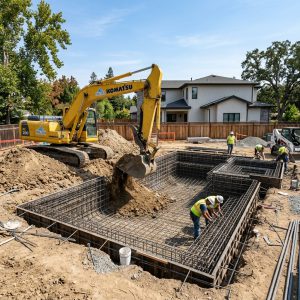
Excavation for a natural pool is similar to conventional pool excavation but typically covers a larger total footprint due to the regeneration zone. A natural pool that delivers 400 square feet of swimming area will require an additional 150–200 square feet (minimum) of regeneration zone, pushing total excavated area to 550–600+ square feet.
Soil conditions are a major cost driver. Rocky or clay-heavy soils require more equipment time and may need soil amendments to achieve stable side slopes. The regeneration zone specifically needs a substrate layer — typically crushed gravel at 4–12 inches depth — which adds material and installation cost.
Lining costs depend on the approach: most natural pools use a high-quality EPDM or reinforced polyethylene liner (similar to large pond liners) or a concrete shell for the swimming zone with a liner in the plant zone. Liner-based systems are typically less expensive; concrete swim zones cost more but offer greater longevity and aesthetic finish options.
Biological Filtration & Plant Zone: $10,000–$30,000
The regeneration zone is the heart of a natural pool and one of its most specialized cost centers. This is not simply adding some water lilies in a shallow area — it involves a precisely engineered substrate system, often a multi-layer gravel bed with defined particle sizes to optimize biological colonization, plus a distribution pipe network to ensure even water flow through the plant root zone.
The plant zone substrate alone can cost $3,000–$8,000 for a mid-sized pool, before any plants are installed. Contractor labor for building out the regeneration zone — setting the substrate layers, installing distribution pipes, and ensuring proper flow dynamics — often represents the most specialized and most expensive labor on the project.
Pumping & Circulation: $5,000–$15,000
Natural pools operate with a fundamentally different pump philosophy than conventional pools. Where a conventional pool runs a high-volume pump to cycle its entire water volume through a filter every 6–8 hours, a natural pool uses a much lower-flow pump designed to move water slowly through the regeneration zone — typical flow rates are 10–25% of what a conventional pool pump would require.
This is actually a long-term cost advantage (lower electricity bills), but the upfront pump specification requires more engineering thought. The pump must be sized precisely to the volume ratio between the swimming zone and regeneration zone, and it must run continuously (or nearly so) to maintain biological activity. Total system cost includes the pump, plumbing runs, skimmer, and any UV clarifier units if specified.
Stone & Hardscaping: $8,000–$25,000
Natural pools are most commonly surrounded by natural stone, timber decking, or planted meadow edges — finishes that complement the ecological aesthetic. This is a highly variable cost center depending entirely on material selection and the total area of hardscaping specified.
Fieldstone coping and naturalistic boulder edges are popular choices but require skilled labor to install attractively. Local stone is almost always less expensive than imported or specialty stone. Timber decking (e.g., hardwood or composite) is often less expensive than full-stone surround but requires ongoing maintenance. For a full comparison of decking options and costs, the pool decking and heating costs guide is an excellent resource.
Initial Planting & Ecosystem Setup: $3,000–$10,000
The plant selection for a natural pool is a specialist area. Not all aquatic plants are appropriate — some are too invasive, some are insufficient filterers, some are not cold-hardy in northern climates. A competent natural pool designer will specify a planting plan that balances filtration performance, aesthetic goals, seasonal interest, and climate appropriateness.
Initial plant costs include the purchase of aquatic plants (typically in quantity — several hundred individual plants for a mid-sized pool), soil or specialized aquatic planting media, and installation labor. This cost also covers the initial ecosystem “seeding” — introducing beneficial bacteria cultures to the substrate to jump-start the biological filter before it would naturally colonize on its own.
Natural Pool vs. Traditional Pool — Full 10-Year Cost Comparison
One of the most common financial arguments in favor of natural pools is the maintenance savings. But does the math actually work? According to 2026 industry data, here is an honest comparison over a 10-year ownership period for a comparable mid-size pool:
| Cost Category | Natural Pool | Traditional Chlorine Pool | Notes |
| Initial Build Cost | $75,000 avg. | $55,000 avg. | Natural pool premium ~$20k |
| Annual Chemical Costs | $0–$100 | $800–$2,000 | Natural pools are essentially chemical-free |
| Annual Energy (pump) | $200–$500 | $500–$1,500 | Natural pool runs lower-flow pump |
| Annual Plant Maintenance | $300–$800 | N/A | Trimming, replanting, thinning |
| Annual Water Testing | $0–$100 | $200–$500 | Periodic biological testing vs. chemical testing |
| 10-Year Liner/Surface Repairs | $2,000–$8,000 | $3,000–$15,000 | Replastering concrete pool is costly |
| 10-Year Total Cost of Ownership | $83,000–$99,000 | $73,000–$105,000 | Ranges overlap significantly |
What this comparison reveals is that the natural pool’s higher upfront cost is genuinely offset over a decade of ownership — particularly when you factor in the mid-life replastering cost (typically $8,000–$15,000) that virtually every concrete conventional pool will require around year 8–12. The fiberglass vs concrete pool cost comparison provides additional context on how conventional pool surface types affect lifetime cost.
What Drives Natural Pool Costs Up?
While the average ranges above give useful planning benchmarks, certain factors can push a natural pool project toward the top of the range — or beyond it.
Size of the Regeneration Zone
The most direct cost multiplier is the size of the regeneration zone relative to the swimming zone. Most natural pool design guides recommend a regeneration-to-swimming area ratio of at least 1:2, meaning for every two square feet of swimming water, you need one square foot of plant zone. Large swimming zones therefore require large plant zones, which means more excavation, more substrate, more planting, and more engineering.
Some high-performance designs push to a 1:1 ratio, dramatically improving water quality and resilience to heavy swimmer loads, but also nearly doubling the total footprint of the water feature. If your backyard is limited in size, this ratio constraint may be the binding factor in what is feasible for your property.
Climate & Heating Requirements
Natural pools are most thermally comfortable in moderate climates (USDA Zones 6–9). In colder climates, the swimming season is inherently shorter, and some owners choose to add supplemental heating — typically solar thermal or a heat pump — to extend the season. Adding a heat pump system adds $3,000–$8,000 to the initial build cost and introduces additional mechanical maintenance.
In very hot climates (the American Southwest, for example), the challenge is different: high temperatures can stress the biological balance of the regeneration zone and promote algae growth. Shading structures, heat-tolerant plant selection, and potentially higher circulation rates are design responses that add cost and complexity to projects in these regions.
Specialist Contractor Scarcity
In Europe, natural pool contractors are common and competitive. In the United States, genuine specialists who have designed and built multiple successful natural pools are still rare — concentrated in the Pacific Northwest, parts of the Northeast, and scattered nationally. This scarcity creates a meaningful labor premium: you may pay 20–40% more for a specialist’s labor than you would for the equivalent hours from a conventional pool contractor.
This is not an area where using a conventional pool contractor with limited natural pool experience is advisable. The ecosystem design is specialized enough that errors — wrong substrate depth, incorrect plant selection, miscalculated flow rates — can result in a chronically green, uninviting pool that fails to function as designed and is expensive to correct.
Natural Pool Maintenance — Is It Really Cheaper?
The promise of chemical-free maintenance is a major selling point, but natural pools are not maintenance-free. They require a different kind of care — less about adding chemicals and more about managing a living system.
Plant Maintenance vs. Chemical Costs
A natural pool’s plant zone requires active management. Aquatic plants grow vigorously during the growing season, and the regeneration zone must be thinned annually — sometimes twice per year in warm climates — to prevent overgrowth that impedes water flow and creates anaerobic (oxygen-deprived) conditions in the substrate. This work is not complicated, but it is physical: removing plant material by hand or with long-handled tools and disposing of the organic matter (which makes excellent compost).
Annual plant maintenance can typically be handled by a homeowner willing to invest 4–8 hours per year, at minimal material cost ($100–$300 for any replacement plants). Hiring a maintenance service to do this work adds $300–$600/year. Compare this to the annual pool maintenance cost calculator numbers for a conventional pool — which typically run $1,200–$3,000/year for chemicals, seasonal opening/closing, and equipment upkeep — and the maintenance savings are real and meaningful.
Algae Management Without Chlorine
The most common concern new natural pool owners have is algae. In the first season after installation, algae blooms are common as the ecosystem establishes itself — this is normal and expected behavior. A well-designed natural pool will self-correct within one to two seasons as the plant community and beneficial bacteria population mature and begin to outcompete algae for dissolved nutrients.
Once established, a properly designed and maintained natural pool should remain clear without chemical intervention. The key management tools if algae appears are: adjusting the plant zone (adding more nutrient-competing plants), checking that circulation is operating correctly, removing excess organic matter from the swimming zone bottom, and in stubborn cases, introducing barley straw extract — a natural algae inhibitor — to the circulation system.
Winter Care for Natural Pools
In northern climates, natural pools need winter preparation, but it is fundamentally different from winterizing a conventional pool. You do not drain a natural pool or add winterizing chemicals. Instead, the process is:
- Reduce or stop pump operation as temperatures drop (the biological system goes dormant naturally)
- Remove submerged pump and skimmer components to prevent freeze damage
- Leave the plants in place — root systems continue minimal biological activity even under ice cover
- Allow the pool to freeze naturally — the ice layer actually insulates and protects the biology below it
Spring startup involves simply restarting the pump and allowing the ecosystem to resume its active state as temperatures rise. There are no chemicals to add, no startup procedures to commission, and no professional opening service required — a meaningful convenience and cost advantage.
Permits & Regulations — The Gray Area
Natural pool permitting is one of the most variable and unpredictable aspects of the entire project, and it is the area where thorough local research before budgeting is absolutely non-negotiable.
In most U.S. jurisdictions, swimming pools are regulated under specific building code provisions that mandate setbacks, safety barriers (fencing), entrapment prevention, and sometimes water quality standards. Natural pools can fall under these regulations — or not — depending on how local authorities choose to classify them.
Some jurisdictions classify natural pools as swimming pools, requiring full pool permits, inspections, safety fencing compliance, and sometimes compliance with water quality standards designed for chemically treated water. This can be a problem, since natural pools cannot meet chlorine-based water quality standards by design.
Other jurisdictions classify them as ponds, requiring only standard landscaping or grading permits, if anything at all. This can dramatically simplify the permitting process and significantly reduce permit fees.
A growing third category consists of jurisdictions that have created — or are actively creating — specific natural swimming pool ordinances that recognize the unique characteristics of these structures. California, Oregon, and a handful of other states have begun this work in response to growing homeowner interest.
Before you budget, consult pool permit costs by state to understand the permit fee landscape in your region, and then contact your local building authority directly to ask how they classify natural swimming pools. This single conversation can determine whether your project costs $500 in permits or $5,000+ — and whether it is even approvable in your zoning district.
Are Natural Pools Right for Your Yard & Climate?
A natural pool is not the right choice for every homeowner or every property. Honestly assessing the following factors will save you significant time and money before committing to a project.
Yard size: You need more land than you would for a comparably sized conventional pool. A natural pool that provides 400 sq. ft. of swimming area will occupy 600–800+ sq. ft. total footprint. If your usable backyard is under 1,500 sq. ft., space constraints may limit what is realistically feasible.
Climate: Natural pools perform best in temperate to moderate climates. In the Pacific Northwest, they are nearly ideal for much of the year. In the Upper Midwest and Northeast, they work well but have a compressed season. In extremely hot, humid climates (Gulf Coast), maintaining biological balance is more challenging but achievable with expert design and climate-appropriate plant selection.
Aesthetic preferences: If your design vision is a tropical resort-style pool with colored lighting, a beach entry, and a waterslide — a natural pool is probably not your project. If your vision is a serene, naturalistic water feature that looks like it always belonged in your garden, it may be exactly right.
Patience with the establishment period: The first swimming season in a new natural pool is typically the most challenging. The ecosystem is still establishing, water clarity may be imperfect, and you may need to intervene more actively than you will in subsequent years. Homeowners who want a perfect swimming experience from day one are often disappointed during this establishment phase.
Long-term engagement: Natural pools reward attentive, engaged owners who enjoy the gardening aspect of their maintenance. Absentee maintenance — ignoring the pool for months at a time — will result in a struggling ecosystem. If you want a pool you can completely ignore for the off-season without any planning, natural pools require more thoughtful winter preparation than conventional alternatives.
Natural pools cost more upfront than a standard inground build, so it helps to know what a conventional pool would actually run in your yard before you commit. Use our fiberglass pool cost calculator to get a baseline install cost you can compare directly against natural pool contractor quotes.
If you are open to a concrete shell instead, run the same yard specs through our concrete pool cost calculator to see whether the custom shape advantage justifies the higher chemical and maintenance costs over time.
Conclusion
A natural pool is not the cheapest way to put water in your backyard — that distinction belongs to above-ground alternatives or a simple liner installation. What a natural pool offers instead is something increasingly rare: a genuinely ecological, chemical-free swimming experience that improves with age, rewards an engaged relationship with the natural world, and looks more like a living garden feature than an outdoor appliance.
With natural pool cost ranges of $50,000–$150,000 and 10-year total cost of ownership increasingly competitive with conventional pool builds, the financial case for going chemical-free is stronger than it has ever been. The keys to a successful project are consistent: an experienced specialist designer, honest local permit research, climate-appropriate plant selection, and a realistic expectation for the first-year establishment period.
Ready to start putting real numbers together for your project? Use our interactive cost estimator at poolcostestimator.com to build a preliminary budget for your natural pool, then connect with a vetted specialist contractor in your region. Your living, breathing backyard ecosystem is closer than you think.
Frequently Asked Questions About Natural Pool Costs
How much does a natural pool cost compared to a regular pool?
A natural pool typically costs $50,000–$150,000 to build, compared to $35,000–$100,000 for a conventional inground pool. The premium is primarily driven by the larger total footprint (swimming zone plus regeneration zone), the specialized contractor expertise required, and the more complex ecosystem engineering involved in design and installation. However, annual maintenance costs for a natural pool run $500–$1,500/year — significantly less than the $1,200–$3,000/year typical of a chemically maintained conventional pool — which narrows the total cost gap considerably over a 10-year ownership period.
How long does a natural pool last?
Natural pools can last 20–30+ years with proper ongoing maintenance. The liner (if used) typically carries a 20–25 year warranty from reputable manufacturers. The ecosystem itself tends to become more resilient and biologically diverse over time, not less stable. Compared to a plaster-finish concrete pool that requires resurfacing every 10–15 years at a cost of $8,000–$15,000, the longevity advantage of a well-built natural pool is financially meaningful over a full ownership period.
Can I heat a natural pool to extend the swimming season?
Yes, but it requires careful consideration of the biological implications. Adding a heat pump or solar thermal system to a natural pool is possible and effective for extending the swimming season by several weeks in each direction. The main caveat is that higher water temperatures accelerate biological activity, which can increase the maintenance demands on the plant zone and require more frequent thinning. Most natural pool designers recommend keeping water temperature below 78°F to maintain optimal biological balance and minimize algae risk.
What plants are used in a natural pool?
The most common plants used in U.S. natural pools include: submerged oxygenators (hornwort, anacharis, water milfoil), emergent plants (cattails, bulrushes, native reeds, blue flag iris), and floating-leaf plants (native water lilies). Invasive species must be carefully avoided — plants like purple loosestrife, common reed (Phragmites australis), and yellow flag iris can escape the pool environment into the surrounding landscape. A specialist designer will specify plants appropriate for your specific climate zone and regional ecology.
How often does a natural pool need maintenance?
Routine maintenance includes: skimming debris from the swimming zone surface (as frequently as with any pool — daily to weekly depending on surrounding trees), seasonal plant thinning in the regeneration zone (1–2 times per year), and periodic pump and skimmer cleaning (monthly during the swim season). Quarterly biological water testing — checking pH, dissolved oxygen, and clarity indicators — is recommended. Total annual hands-on time is typically 20–40 hours for a homeowner-maintained natural pool of average size.
Can I convert an existing conventional pool to a natural pool?
In some cases, yes — conversion is possible. The process involves partitioning the existing pool into a swimming zone and a regeneration zone, installing a substrate system in the plant zone section, removing the chemical treatment systems, and introducing appropriate planting. The feasibility depends on the existing pool’s geometry (it needs enough surface area to accommodate an adequate plant zone, ideally 30%+ of total surface), structural condition, and local permit requirements. Conversion costs typically run $20,000–$50,000 — less than a new build but not trivial. An experienced specialist contractor’s assessment is essential before committing to conversion.